

What Can a 3kW Solar System Run? Appliances Guide

A 3kW solar system is one of the most popular residential sizes in Pakistan, and for good reason: it comfortably powers the daytime essentials of a small household — LED lights, ceiling fans, an LED TV, Wi-Fi router, laptop, and a refrigerator — and can run one medium appliance at a time, such as a washing machine or microwave. The direct answer to what can a 3kW solar system run in Pakistan is: almost everything a small home needs during the day, as long as heavy loads are managed and not all switched on at once.
The catch is that 3kW is both a power limit and an energy budget. Exceed the power limit and the inverter trips; exceed the daily energy budget and you run out of sunlight. This guide explains both limits in plain terms, maps common Pakistani household appliances to a 3kW system, and shows how to get the most out of every panel.
What Does “3kW” Actually Mean?
The “3kW” rating describes peak power output: the maximum electricity the panels can produce under ideal test conditions. In real life, panels rarely sit at peak for long — heat, dust, clouds, and the angle of the sun all reduce output. What matters for planning is the difference between watts (power at one moment) and watt-hours (total energy over time), a distinction Growatt’s reference guide on what a 3000-watt solar system can run explains well.
Think of it this way: watts are the size of the pipe, watt-hours are the total water that flows through it. A 3kW system is a fairly wide pipe, but the total water depends on how many hours of good sunshine you get — which brings us to the daily energy budget.
How Much Energy Does a 3kW System Produce Daily in Pakistan?
Energy produced over a day matters more than the peak watt number, because it decides how many hours your appliances can actually run. Pakistan enjoys strong sunshine for most of the year, and a well-installed 3kW rooftop array typically generates a comfortable double-digit number of units (kWh) on a clear day — enough to cover a small home’s daytime consumption several times over.
The exact figure depends on panel tilt, orientation, shading, dust, and the season. We calculate the detailed math, month by month, in our companion guide on how many units a 3kW solar system produces per day. For appliance planning, the key takeaway is: there is plenty of energy during daylight hours; the constraint is how much power you draw at one moment.
Appliances a 3kW Solar System Can Run
A safe rule of thumb: keep your simultaneous continuous load at roughly 60 to 80 percent of the 3kW rating — about 1,800 to 2,400 watts. That headroom handles motor startup surges (refrigerators, pumps), passing clouds, and inverter efficiency. Within that envelope, here is what a 3kW system can comfortably run, with typical wattages:
Everyday essentials (run all day without worry)
- LED lights (10–12 bulbs): around 100–150W total — a tiny fraction of capacity.
- Ceiling fans (4–5 fans): roughly 70–75W each, or about 350W for the whole house.
- LED TV (32–55 inch): 60–250W depending on size, per Growatt’s appliance wattage reference.
- Laptop and phone charging: 50–100W — negligible against 3kW.
- Wi-Fi router: around 10W — runs essentially free.
- Refrigerator: 120–200W while running; the compressor’s startup surge is brief, which is why the headroom rule matters.
Medium appliances (run one at a time alongside the essentials)
- Washing machine: 500–1,200W depending on the cycle and whether it heats water.
- Microwave oven: 600–1,200W — fine for short bursts.
- Iron: around 1,000W — fine for an hour, just not together with the washing machine.
- Water pump (1 HP): roughly 750W running, but with a high startup surge — stagger it away from other loads.
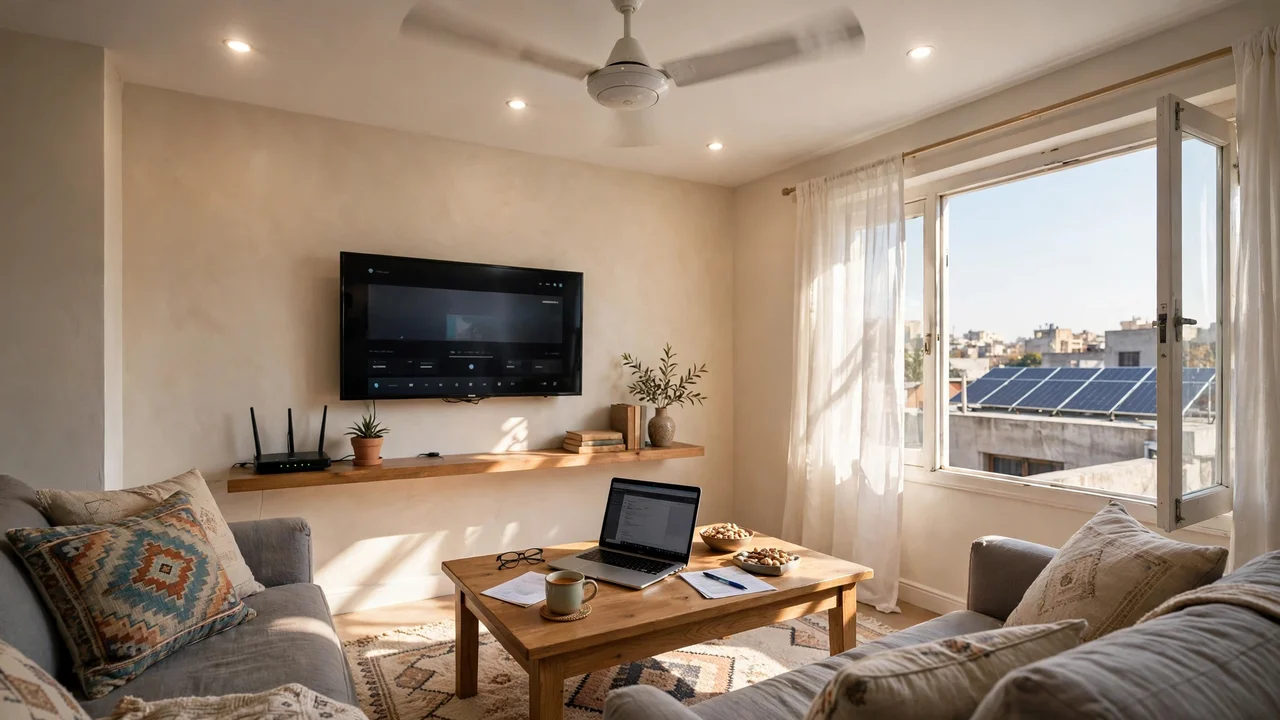
Together, a typical daytime scene — lights, fans, TV, fridge, router, and a laptop — draws well under 1,000W. That leaves generous headroom to run the washing machine or microwave at the same time. If you have not yet mapped your own home’s loads, our guide on calculating your home’s electricity load for solar walks through the full method.
Realistic Daytime Load Scenarios
Theory is useful; scenarios make it concrete. Here are two realistic Pakistani household days on a 3kW system:
Scenario 1: A summer weekday
Morning: lights, 4 ceiling fans, fridge, and the water pump filling the rooftop tank for 30 minutes (staggered before the washing machine starts). Midday: fans, TV, fridge, router, and laptop while someone works from home. Afternoon: washing machine runs a full cycle while everything else stays on — the combined load stays under 2,000W. Evening: iron for 30 minutes after the washing machine finishes.
Scenario 2: A winter weekend
Lower fan use frees up capacity. The microwave reheats lunch while the fridge cycles and the TV plays in the background. A small electric room heater is not part of this picture — resistive heating is the fastest way to overwhelm a 3kW system, as explained below.
The pattern is the same in both scenarios: stagger, don’t stack. Run heavy appliances one at a time, and a 3kW system rarely breaks a sweat.
What a 3kW System Cannot Run
Knowing the limits is as important as knowing the capabilities. The following are beyond a 3kW system’s safe capacity, either individually or in combination:
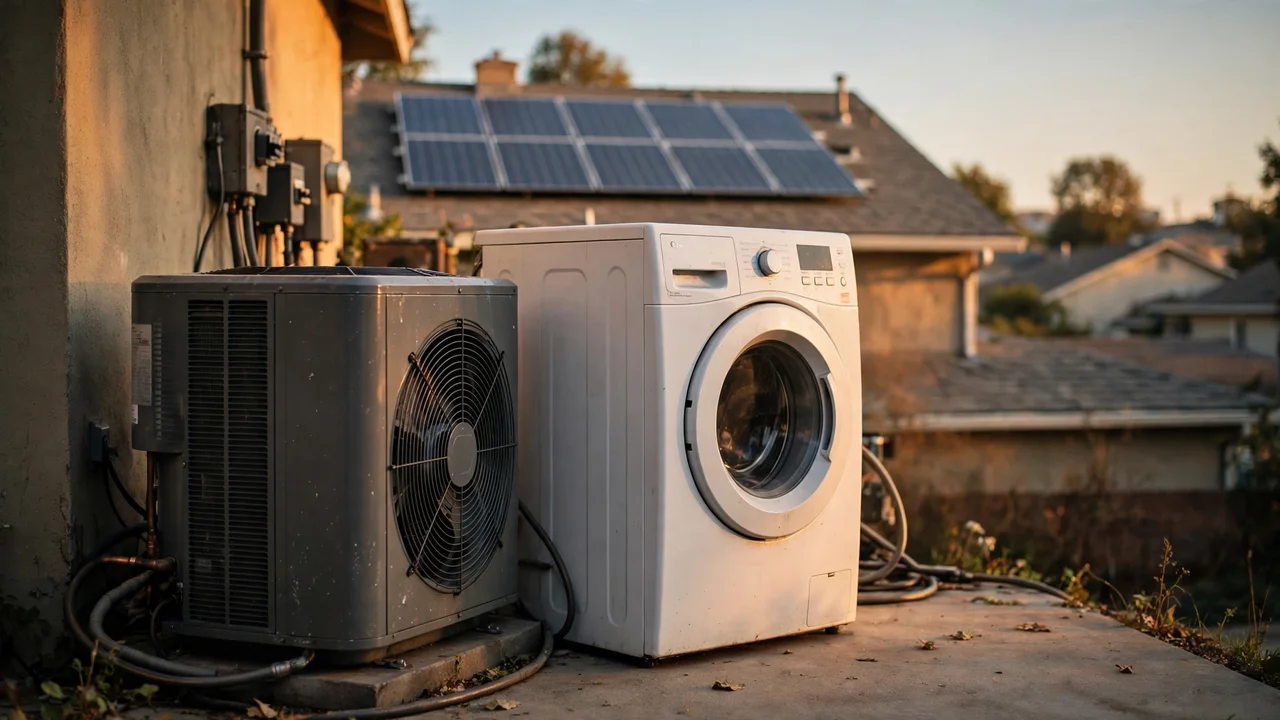
- Large air conditioners: a conventional 1.5-ton AC draws roughly 1,500–2,000W running and surges higher at startup — too much to run alongside normal household loads. A small 1-ton inverter AC (roughly 900–1,200W running) can work if other heavy appliances are off, but this needs careful planning and is the edge case, not the norm.
- Electric geysers and instant water heaters: 2,000–4,000W — single-handedly exceed the safe envelope.
- Electric stoves and heaters: resistive heating elements are the heaviest residential loads; a 3kW system is not designed for them.
- Multiple heavy appliances at once: washing machine + microwave + iron + pump simultaneously will trip the inverter. One at a time works; all together does not.
On-Grid, Off-Grid or Hybrid: Which 3kW Setup for Pakistan?
The same 3kW of panels behaves differently depending on the system architecture:
- On-grid: the simplest and most common choice. Daytime loads run directly on solar, surplus exports to the grid through net metering, and the grid covers nights and cloudy spells. No batteries needed.
- Hybrid: adds battery storage, so evening essentials — lights, fans, TV, fridge — keep running during load shedding. Note that many hybrid inverters can even run without batteries if you want to add storage later.
- Off-grid: for areas without reliable grid access. Everything depends on panels plus batteries, so the energy budget must be planned more strictly.
For most Pakistani homes, on-grid with net metering gives the best value, while hybrid is the answer where load shedding is frequent. If you are unsure which inverter type fits, our solar inverter buying guide for Pakistan compares the options in detail.
Inverter and Battery Sizing for a 3kW System
The inverter converts your panels’ DC power into the AC power your appliances use. For a 3kW array, installers typically pair a 3.2 to 3.6 kW pure sine wave inverter — slightly above the panel rating so it never runs at 100 percent all day, which improves efficiency and lifespan. Pure sine wave output is important for motors (fridge compressors, pumps) and sensitive electronics.
Batteries are only needed for hybrid or off-grid setups. Sizing them is a separate calculation based on which loads must survive the night and for how long — our guide on calculating solar battery backup time covers the method, and the best battery for solar system in Pakistan guide compares the battery types worth pairing with a 3kW array.
Tips to Get the Most Out of a 3kW System
- Schedule heavy loads for peak sun hours (roughly 10 am to 3 pm), when the panels produce the most.
- Switch to LED lighting and inverter fans — cutting base load leaves more capacity for everything else.
- Keep panels clean and unshaded: dust and partial shade silently shrink your energy budget.
- Monitor your inverter’s app or display to learn your household’s real consumption pattern, then schedule loads around it.
- Plan for growth: if you expect an AC or an electric vehicle later, leave roof space and choose an inverter that supports expansion. Our guide on how many solar panels you need helps with the sizing math.
Who Is a 3kW Solar System Right For?
A 3kW system is the sweet spot for 1 to 2 bedroom homes, small apartments, and compact offices in Pakistan — households whose daytime loads are lights, fans, a fridge, entertainment, and one medium appliance at a time. If your needs are smaller — just lights, fans, TV and a small fridge — the 1kW system guide shows how much less you can get away with. If you need air conditioning across multiple rooms or run a business with heavy machinery, you are looking at 5kW and above instead.
Once you’ve matched appliances to a 3kW system, check the solar system price in pakistan and the solar inverter price in pakistan on our daily-updated homepage tables.
Frequently Asked Questions (FAQs)
What can a 3kW solar system run in Pakistan?
u003cpu003eA 3kW solar system comfortably runs the daytime essentials of a small Pakistani home: LED lights, ceiling fans, an LED TV, Wi-Fi router, laptop and phone charging, plus a refrigerator. It can also run one medium appliance at a time — a washing machine, microwave, iron or 1 HP water pump — as long as heavy loads are staggered and not all switched on together.u003c/pu003e
Can a 3kW solar system run an air conditioner?
u003cpu003eIt depends on the size. Large or conventional 1.5-ton air conditioners are beyond a 3kW system’s safe capacity. A small 1-ton inverter AC (roughly 900 to 1,200W running) can work if all other heavy appliances are switched off — but running an AC alongside normal household loads is not realistic on 3kW.u003c/pu003e
How much load can a 3kW solar system handle safely?
u003cpu003eKeep simultaneous continuous load at roughly 60 to 80 percent of the 3kW rating — about 1,800 to 2,400 watts. This headroom handles motor startup surges from refrigerators and pumps, passing clouds, and inverter efficiency losses.u003c/pu003e
Can a 3kW solar system run a 1.5 ton AC?
u003cpu003eNo. A 1.5-ton air conditioner draws roughly 1,500 to 2,000W while running and surges higher at startup, which exceeds a 3kW system’s safe continuous capacity. Homes that need 1.5-ton or larger ACs should look at 5kW systems and above.u003c/pu003e
Does a 3kW solar system work at night?
u003cpu003eOnly with battery storage or the grid. An on-grid 3kW system produces power during daylight hours; at night it draws from the grid. A hybrid or off-grid 3kW setup with properly sized batteries can carry evening essentials like lights, fans, a TV and a refrigerator through the night.u003c/pu003e
What size inverter is needed for a 3kW solar system?
u003cpu003eA 3kW solar array is typically paired with a 3.2 to 3.6 kW pure sine wave inverter. The slight oversizing keeps the inverter from running at 100 percent all day, improving efficiency and lifespan, while pure sine wave output protects motors and sensitive electronics.u003c/pu003e
Can a 3kW system run a washing machine and refrigerator at the same time?
u003cpu003eYes, as long as total simultaneous load stays within the safe envelope of about 1,800 to 2,400W. A washing machine (500 to 1,200W) plus a running refrigerator (120 to 200W) plus lights and fans fits comfortably — just avoid switching on a third heavy appliance like the microwave or iron at the same moment.u003c/pu003e
Is a 3kW solar system enough for a small house in Pakistan?
u003cpu003eYes — a 3kW system is the sweet spot for 1 to 2 bedroom homes and small offices whose daytime loads are lights, fans, a fridge, entertainment, and one medium appliance at a time. Homes needing multiple air conditioners or heavy machinery should consider 5kW or larger systems.u003c/pu003e