
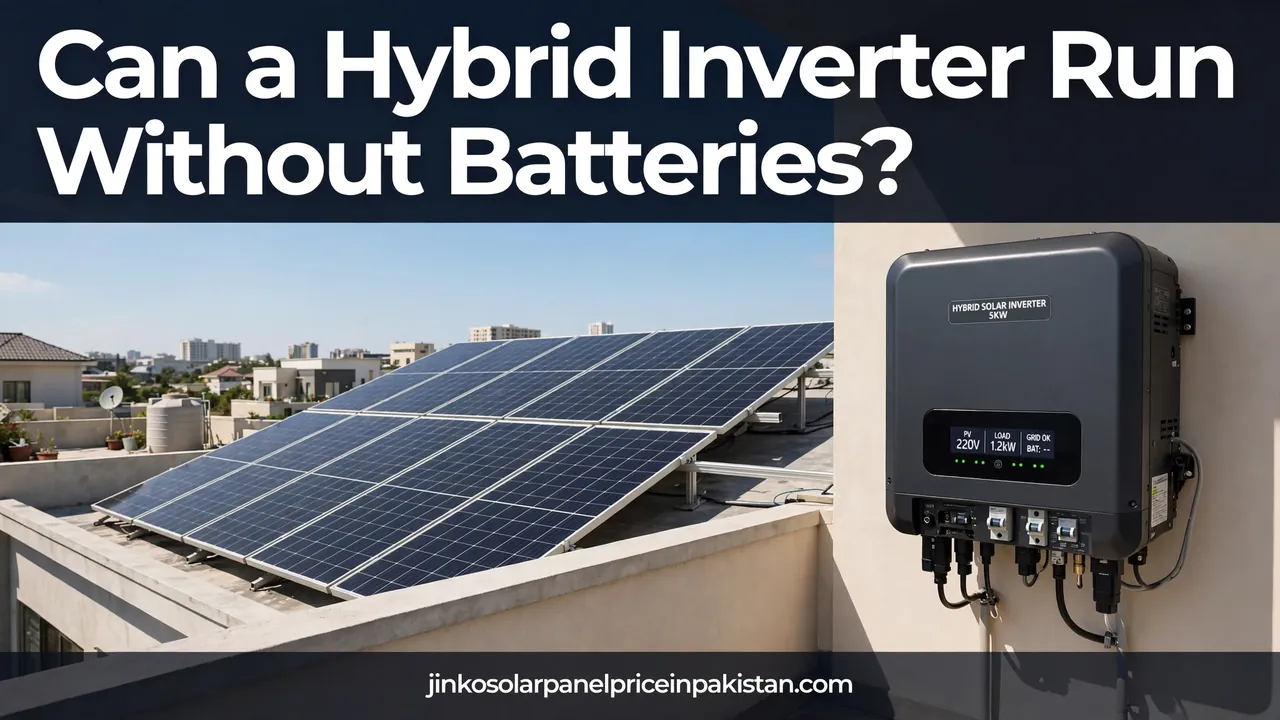
Can a Hybrid Inverter Run Without Batteries?

Yes, many hybrid inverters can run without batteries — but not every model can, and the ones that can behave very differently from a battery-backed system. Without a battery, a hybrid inverter usually works like an on-grid inverter during the day: it converts solar power for your home and, where your connection allows it, sends surplus power to the grid. What it cannot do without a battery is store energy for the night or keep your home running during a power outage. So the short answer is yes for many models, provided you buy a model that explicitly supports batteryless operation and you accept those two limits.
What “Without Batteries” Actually Means
A hybrid inverter is designed to manage three sources of power: solar panels, a battery, and the grid. Remove the battery and you remove only the storage part of that job. The inverter still converts the direct current (DC) from your panels into alternating current (AC) for your home, still tracks the maximum power point of your panels, and still decides — within the limits of its settings — whether surplus power goes to your loads or to the grid.
This is why manufacturers often describe batteryless operation as “string inverter mode” or “on-grid mode.” The inverter is not doing anything exotic; it is simply running without the storage function switched on. Its battery charging, discharging, and backup routines have nothing to manage, so they stay inactive.
That distinction matters because people sometimes assume a hybrid inverter without a battery is a half-finished system. It is a working solar system with storage deliberately missing, and the consequences of that missing piece are specific and predictable.
How a Hybrid Inverter Works Without a Battery
During daylight, your panels produce DC power. The inverter converts it to AC and supplies your running appliances first. If your panels produce more than your home is using at that moment, the surplus follows the export setting you or your installer chose: it is either sent to the grid (where export is allowed and a net metering arrangement is in place) or curtailed so that nothing flows back to the grid (where export is limited or not allowed).

When a cloud passes or your load suddenly rises above what the panels are producing, the inverter draws the shortfall from the grid, assuming the grid is present. There is no battery to smooth out those dips, so the system is only as steady as the sunlight and the grid connection at that moment.
At night, with no panels producing and no battery to draw from, the system simply stops supplying solar power. Your home runs entirely on grid power, just as it did before solar was installed.
Some models also need a minimum amount of solar or grid power simply to start up in the morning. If your installer has sized the array correctly and the model supports batteryless start-up, this happens automatically. If a model requires a battery to establish its internal DC voltage, it will not start without one at all — which is why the model check in a later section is not optional.
What You Lose Without Batteries
No Backup During a Power Outage
This is the most important limit. A grid-connected inverter — hybrid or not — shuts down its solar output during a grid outage unless it has a battery-backed backup circuit and an islanding arrangement that safely disconnects your home from the grid. Without a battery, there is no stored energy to form that backup supply, so your home loses power along with the grid, even in bright sunshine. If backup during load shedding is your main reason for choosing a hybrid inverter, running it without batteries defeats that purpose until batteries are added.
No Night-Time Solar Power
Without storage, solar energy that is not used the moment it is generated cannot be saved for later. Evening loads — lights, fans, television, cooking — run on grid power. A net metering arrangement can soften this financially where it applies, because exported daytime units earn credit against later consumption, but that is a billing mechanism, not stored energy. It does not keep a single light on during an outage.
No Buffer Against Clouds and Load Spikes
A battery absorbs short mismatches between generation and consumption: a passing cloud, a motor starting, a sudden load. Without one, those mismatches are handled by the grid or by curtailing output. In a home with steady daytime consumption this is barely noticeable. In a home with sharp, intermittent loads, it means more of your solar output may be curtailed or exported at moments when you cannot use it.
What Still Works Without Batteries
Daytime self-consumption works fully. If you run washing machines, water pumps, air conditioning, or workshop tools during sunny hours, a batteryless hybrid system supplies them directly from your panels, reducing the grid power drawn at those times. Homes and small businesses with high daytime use therefore get the most value from this setup.
Grid export and net metering can also work, subject to your distribution company’s rules and your meter arrangement. In that case the grid effectively acts as your “storage” in billing terms: surplus daytime generation is credited, and you draw against that credit later. This is not the same as physical storage — it gives no outage protection — but it is a legitimate reason many people start without batteries. For the process side of that arrangement, see our net metering policy guide and our on-grid solar inverter guide.
Monitoring, safety protections, and anti-islanding behaviour also work normally. The inverter still disconnects from the grid during an outage for the safety of line workers, still reports generation through its app or display where fitted, and still protects against faults. None of those functions depend on a battery being present.
When Running Without Batteries Makes Sense
A batteryless hybrid setup suits you if your daytime consumption is high and steady, if you have a net metering arrangement that credits exports, if outages are rare in your area or are not your main concern, or if you plan to add batteries in a defined next step and want the inverter ready for them now. It is a common staging strategy: buy the hybrid inverter once, run it batteryless while the budget or the battery decision settles, then add a compatible battery later without replacing the inverter.
It suits you less well if your main problem is load shedding, if most of your consumption happens in the evening, if your connection does not allow export and your daytime consumption is low, or if you need backup for essential loads such as medical equipment, a home office, or refrigeration. In those cases the honest answer is that batteries are not an optional extra; they are the part of the system that solves your actual problem. Our best battery for solar systems guide explains the battery types and sizing questions to work through before deciding.
Not Every Hybrid Inverter Can Do This — Check Before You Buy
This is where buyers get caught. Some hybrid inverters are explicitly designed for batteryless operation and list it in their datasheet or manual. Others require a battery to start up, to form their internal voltage, or to operate at all, and will show a fault such as “battery not connected” if you try to run them without one. A third group sits in between: it can run batteryless in grid-connected mode but not in off-grid mode, or it can run batteryless only above a minimum solar input.
Before you buy, ask your supplier or installer to confirm in writing, for the exact model — not just the brand — that it supports operation without a battery, in which modes, and under what minimum conditions. Check the manual’s operating-mode section yourself if you can. SolaX, for example, documents that its X1-Hybrid-LV operates as a traditional string inverter when no battery is connected, with battery-related modes inactive in that configuration — a useful example of the kind of explicit manufacturer statement to look for. See SolaX’s official note on operating the X1-Hybrid-LV without a battery.
Two further cases deserve a specific warning. First, parallel systems — where two or more hybrid inverters are linked together — generally require a shared battery bank to provide a common voltage reference and synchronisation; batteryless operation is typically not supported in parallel configuration even when a single unit supports it alone. Second, some models support batteryless operation only as an emergency or temporary mode, not as a long-term configuration. Neither case is a defect; both are design limits that should be known before the purchase, not discovered after installation.
For the wider choice of inverter type, our solar inverter buying guide for Pakistan and our on-grid vs off-grid vs hybrid inverter comparison put batteryless operation in context alongside the other types.
Adding Batteries Later: What to Check Now
If you plan to add batteries later, the decisions you make now determine how smooth that upgrade will be. First, confirm battery compatibility: voltage range, chemistry (commonly lithium iron phosphate or tubular lead-acid in Pakistan), communication protocol, and the maximum battery capacity the inverter supports. An inverter bought for one battery family may not accept another without additional equipment.
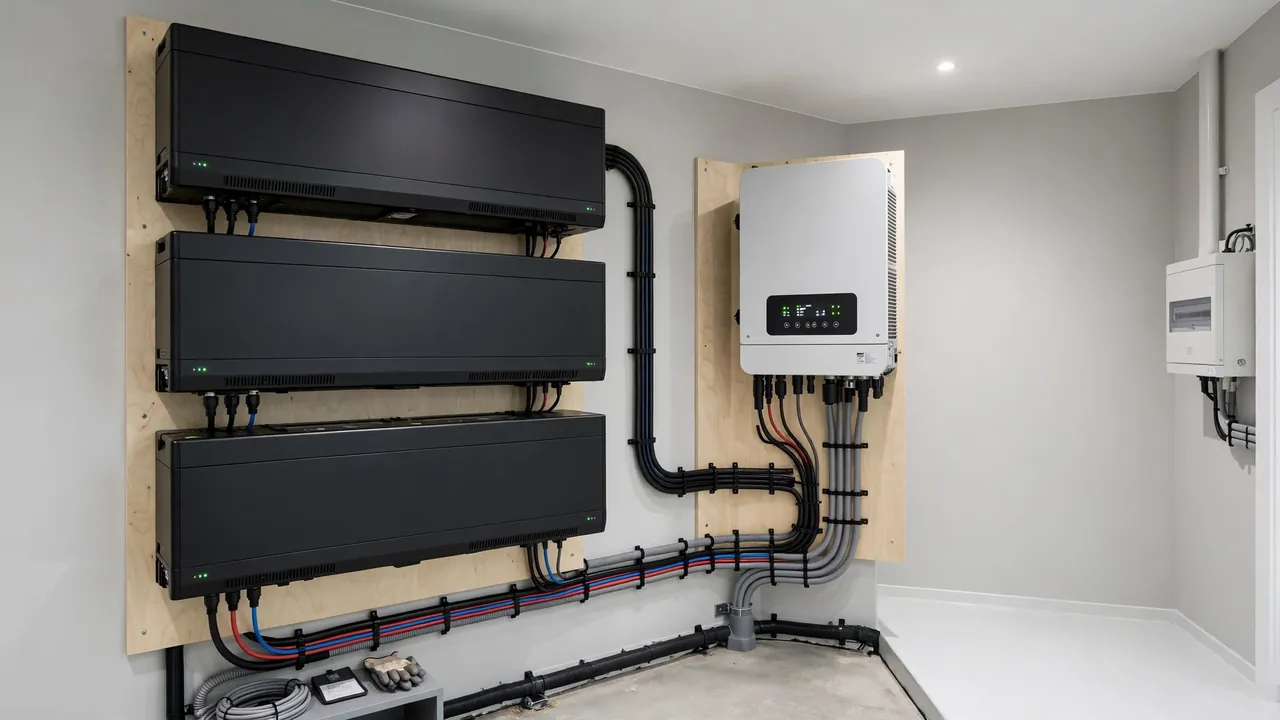
Second, leave physical and electrical room for the battery: wall or floor space, ventilation, cable routes, and spare capacity in the distribution board. Third, agree the settings plan with your installer in advance — which loads will be backed up, what depth of discharge is appropriate for the battery type you intend to buy, and how export settings should change once storage is present. Our inverter and battery pairing guide walks through that matching process in detail.
Finally, keep the paperwork: the manual’s batteryless section, the datasheet, and your installer’s written confirmation. File them with the rest of your system documents.
Common Mistakes to Avoid
The first mistake is assuming every hybrid inverter is batteryless-capable because the word “hybrid” suggests flexibility. It suggests a range of modes, not a guarantee of any one mode. The second is assuming a batteryless hybrid system provides backup. It does not, and discovering that during the first outage is an expensive lesson. The third is sizing the array for a battery system you do not yet have — for example, oversizing panels in the hope that surplus will somehow be stored — when without a battery and without export, that surplus is simply curtailed.
The fourth mistake is ignoring the export rules for your connection. If export is not allowed and you have no battery, every unit above your instantaneous consumption is wasted. In that situation, either size the array tightly to your daytime load, add a zero-export arrangement, or bring the battery decision forward. The fifth mistake is mixing modes without understanding them: battery-related settings have no practical effect without a battery, and changing them will not create storage, backup, or night-time power.
For a fuller picture of what a hybrid inverter is designed to do with and without storage, see our hybrid solar inverter guide and the ranked options in our top 5 best hybrid inverters list — remembering that a ranked list is a starting point for comparison, not a substitute for checking the exact model’s manual.
Check Current Prices
Solar equipment options change regularly, and the right model for a batteryless setup depends on the exact model’s documented modes, not on a general rule. For today’s updated solar panel tables, visit our homepage at jinkosolarpanelpriceinpakistan.com, where panel options are updated daily. Use those tables alongside your installer’s written confirmation of batteryless support before you finalise any purchase.
Can a hybrid inverter run without batteries?
Yes, many models can. Without a battery, a hybrid inverter usually works like an on-grid inverter during the day, converting solar power for your home and exporting surplus where your connection allows it. Check the exact model’s manual first, because some models require a battery to start or operate.
Will a hybrid inverter give backup power during load shedding without a battery?
No. Without a battery there is no stored energy to supply your home during an outage, and a grid-connected inverter shuts down its solar output during an outage for safety. Backup power needs a battery and a backup circuit arranged by your installer.
Can a hybrid inverter export power to the grid without a battery?
It depends on your connection and meter arrangement. Where export and net metering are allowed, surplus daytime power can be exported and credited. Where export is not allowed, surplus above your instantaneous consumption is curtailed and wasted unless you add storage or a zero-export arrangement.
Can I add batteries to a hybrid inverter later?
Usually yes, if the inverter and the battery you choose are compatible in voltage, chemistry, communication, and capacity. Confirm compatibility in writing before buying either part, and agree with your installer which loads will be backed up once the battery is added.
Do all hybrid inverters work without batteries?
No. Some models need a battery to establish their internal voltage or to start at all, and will show a fault such as battery not connected if run without one. Others support batteryless operation only in grid-connected mode, or only above a minimum solar input. Always check the exact model’s datasheet and manual.
What happens at night if my hybrid inverter has no battery?
At night your home runs entirely on grid power, because the panels are not producing and there is no battery to draw from. A net metering credit can offset the bill for exported daytime units, but it is a billing mechanism, not stored energy, and it gives no outage protection.
Is a batteryless hybrid inverter the same as an on-grid inverter?
In daytime behaviour they are similar: both convert solar power for immediate use and export surplus where allowed. The difference is that a hybrid inverter is built to accept a battery later and manage backup circuits, while a standard on-grid inverter is not designed for storage or backup at all.
What should I check before buying a hybrid inverter to run without batteries?
Ask the supplier to confirm in writing, for the exact model, that it supports operation without a battery, in which modes, and under what minimum conditions. Also check the export rules for your connection, your daytime consumption pattern, and whether the battery you may add later is compatible.
