
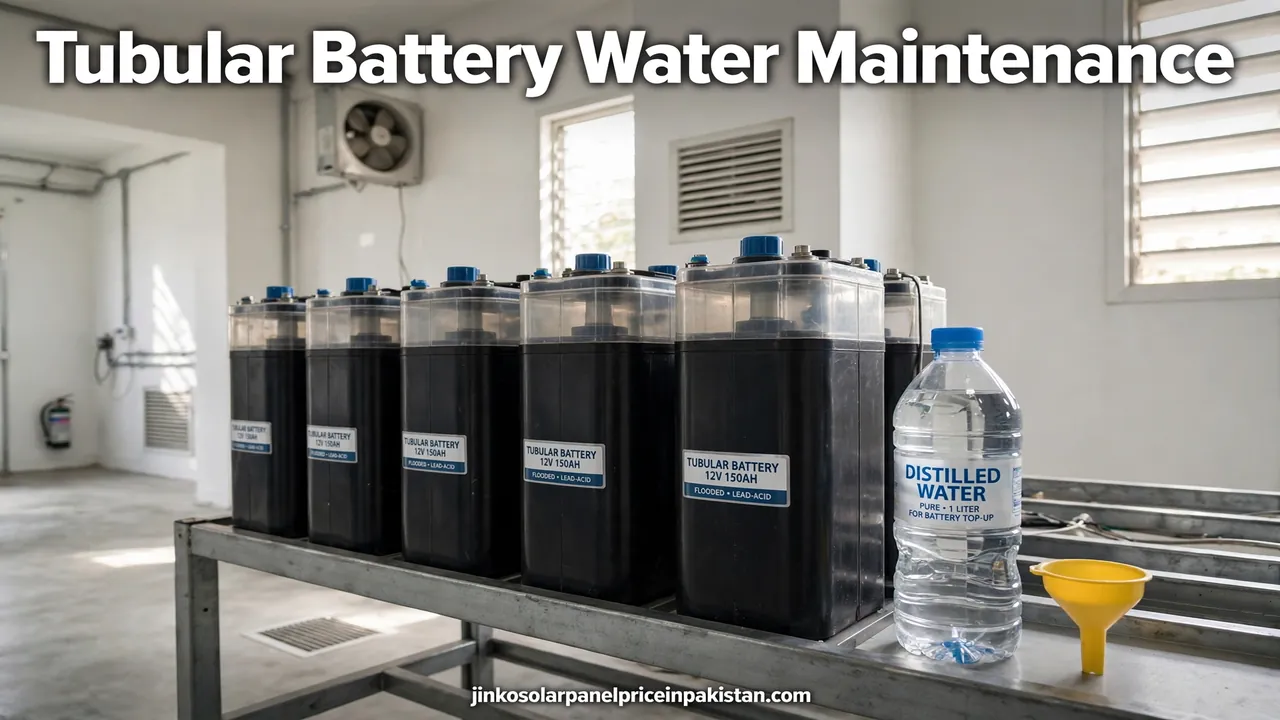
Tubular Battery Water Maintenance: Distilled Water Guide

Tubular battery water maintenance is simple once you know the routine: check the electrolyte level regularly, top up with distilled water only, and always add water after a full charge rather than before it. Done this way, watering keeps the plates covered, the chemistry balanced, and your solar battery bank working the way it should. Done carelessly — with tap water, overfilling, or topping up at the wrong time — the same job can shorten battery life instead of extending it.
This guide covers the full routine for flooded tubular batteries in home solar systems in Pakistan: why the level drops, how often to check it, the correct fill level, the topping-up method, and the mistakes to avoid. Sealed, dry, AGM, gel and lithium batteries are built differently and must never be opened or topped up.
Why Tubular Batteries Lose Water
A flooded tubular battery stores energy in liquid electrolyte — a mixture of sulphuric acid and water — that surrounds the lead plates inside each cell. During charging, especially in the final stage of the charge, part of the water in the electrolyte breaks down into hydrogen and oxygen gas and escapes through the vent caps. This gassing is normal, but it means the water level falls a little with every charge cycle.
Two things make the level fall faster. The first is heat: in a hot battery room, or during Pakistan’s long summer months, evaporation and gassing both increase. The second is heavy cycling: a battery discharged deeply every day and recharged fully each time gases more than one that is lightly used. Daily load shedding cycles therefore mean more frequent checks.
The acid itself does not evaporate. Only the water is lost, which is why you replace lost water with pure water — never with acid. Adding acid would raise the acid concentration beyond what the plates are designed for and damage them.
Distilled Water Only: Why the Type of Water Matters
Only distilled water or deionized water should go into a flooded tubular battery. Distilled water is pure water with the dissolved minerals removed. Tap water, by contrast, carries dissolved minerals such as calcium and magnesium. Those minerals do not leave the battery once added: they settle on the plates, interfere with the chemical reaction, encourage corrosion, and gradually reduce the battery’s capacity.
The same rule excludes bottled and mineral water, which also contain dissolved minerals, and ordinary filtered water, which removes particles but not dissolved salts. If distilled water is unavailable, deionized water from a battery shop is the accepted alternative — but check it is genuinely deionized, not just filtered drinking water. Keep a dedicated, labelled bottle for battery water, and never use a container that previously held acid, oil or chemicals.
How Often Should You Check the Water Level?
As a baseline, check the electrolyte level of every cell once a month. Until you know your own battery’s habits, monthly checks are the safe routine recommended by battery manufacturers, and our solar battery maintenance guide uses the same schedule for the wider care routine.
Check more often during the hot summer months, when the bank is cycled deeply every day, or after several days without a full recharge. If you find yourself topping up the same bank every week, that is not a normal routine — it is a warning sign, covered in the troubleshooting section below.
Check every cell, not just one. Cells in the same bank do not always use water at the same rate, and a single dry cell can drag down the whole bank.
How to Read the Water Level
Most flooded tubular batteries show the correct level as an indicator ring or float inside the cell, a minimum/maximum mark on the cell wall, or a vent well the electrolyte should sit just below. Your battery’s manual states the correct level for that model — follow it, because fill levels differ slightly between makers.
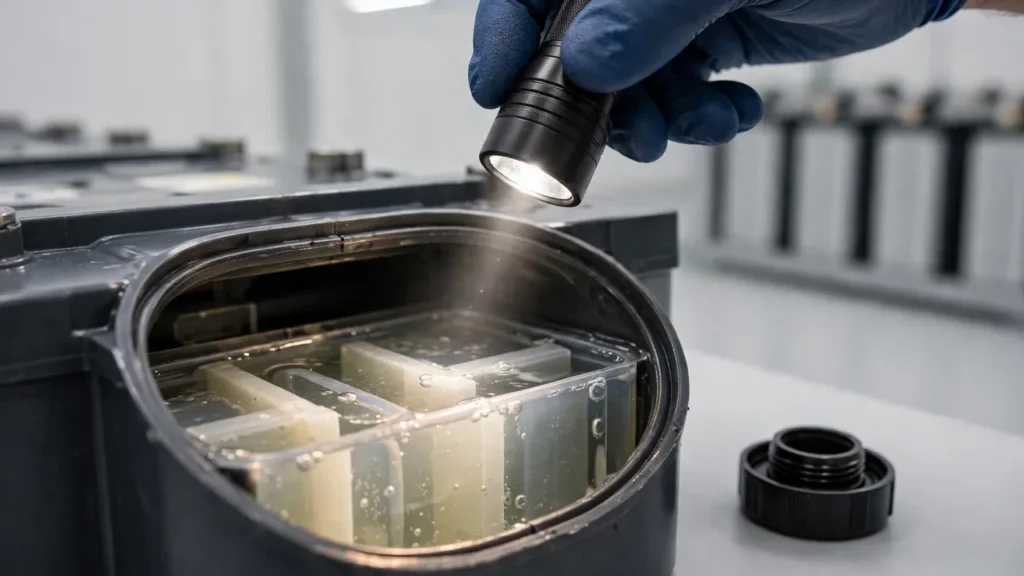
To check, switch the inverter off, put on safety glasses and gloves, and remove the vent caps one cell at a time. Look into the cell with a torch: the plates should be fully submerged. If the top edge of any plate is visible above the liquid, that cell needs water urgently — exposed plates dry out and harden, damage that cannot be fully reversed.
Never check the level by tipping or shaking the battery, and never insert metal objects such as screwdrivers or wires into a cell. Both risk short circuits and acid splashes.
Step-by-Step: How to Top Up a Tubular Battery
Follow this order every time. The single most important rule is the timing: top up after a full charge, not before it.
1. Charge the battery fully first
Run a complete charge cycle before watering. Charging raises the electrolyte level as the battery warms and gases, so a level that looks low before charging may be correct once charging is finished. Topping up before charging is the most common cause of overfilling: the level rises during charging, spills acid out of the vent caps, corrodes the terminals and the battery stand, and leaves the cells under-filled once the level settles again.
There is one exception. If the plates are already exposed before charging, add just enough distilled water to cover them, then charge fully, and only then top up to the correct level. Charging with dry, exposed plates damages them, so covering them first takes priority over the normal order.
2. Prepare safely
Work in a ventilated area, away from flames and sparks, because charging produces flammable hydrogen gas. Wear safety glasses and chemical-resistant gloves, and keep clean water nearby in case of splashes. Switch the inverter off and disconnect the load before opening the cells. If acid touches your skin, wash it off immediately with plenty of clean water.
3. Fill each cell slowly
Remove the vent caps and, using a small funnel, a squeeze bottle or a battery watering bottle, add distilled water to each cell a little at a time. Fill to the manufacturer’s marked level — typically just below the bottom of the vent well or to the indicator ring — and stop there. Do not fill to the very top of the cell or into the vent tube itself.

4. Replace the caps and clean up
Replace every vent cap firmly, wipe any drips from the battery top with a damp cloth, and check that no caps are loose or missing. A loose cap lets dust in and acid vapour out, and a missing cap is a safety hazard. Record the date of the top-up on a simple log — a notebook near the battery bank or a note on your phone — so the monthly routine stays on track and unusual water use is easy to spot.
Common Watering Mistakes to Avoid
Using tap water. Even once, tap water adds minerals that stay in the battery. If tap water has been added by mistake, do not drain the cell to fix it — that removes acid as well. Note it in your log and return to distilled water for all future top-ups.
Overfilling. Filling to the brim causes acid to bubble out during the next charge, corroding terminals, cables and the stand. If you overfill a cell, leave the cap off briefly only in a safe, ventilated spot and let the level settle — never siphon acid out by mouth or with an unprotected container.
Adding acid. Never add sulphuric acid or “battery acid” during routine maintenance. Acid is only handled during manufacture or by a professional during a repair. The electrolyte’s acid component does not evaporate, so only water needs replacing.
Watering a sealed battery. Dry, AGM, gel and lithium batteries are sealed by design. They have no vent caps to open, and forcing them open destroys the battery and voids any warranty. If a sealed battery is losing capacity, the answer is a proper diagnosis, not water. Our types of solar batteries guide explains which types need watering and which do not.
Watering only some cells. Skipping cells creates imbalance: some cells stay strong while others run dry. In a bank wired in series or parallel, the weakest cell limits the whole bank, so check and top up every cell at every visit. See our series vs parallel battery wiring guide for how cells and batteries in a bank work together.
Water Maintenance Through Pakistan’s Seasons
Summer is the demanding season. High room temperatures and heavy daily cycling push water loss up, so move to checks every two to three weeks in the hottest months and keep the battery room as cool and shaded as you can.
In winter, water use slows, and the monthly routine is usually enough. Do not skip winter checks entirely: a cell that runs low unnoticed over winter still suffers exposed-plate damage. After any long idle spell, check the levels before returning the bank to heavy daily use, and confirm the charger settings still match the battery type. Keep the battery tops clean and dry, and the bank ventilated, shaded and out of reach of children.
When Frequent Top-Ups Signal a Bigger Problem
A bank that suddenly needs water far more often than before is telling you something. The most common causes are a charger set to too high a voltage, a charger that never finishes its charge cycle and keeps gassing, a battery room that has become much hotter, or a cell that is failing and gassing excessively. Check the charger settings against the battery maker’s specification first — wrong settings are the easiest cause to fix and the most damaging to ignore.
Watch for one cell that always needs more water than its neighbours — it usually means that cell is ageing faster or has an internal fault. Likewise, if backup time is falling even though water levels are correct, the problem lies elsewhere, and watering will not restore it. Our guides on how long solar batteries last and the signs your solar battery needs replacement explain how to tell routine ageing from a fault worth acting on.
If you are unsure, have the bank tested by a qualified solar technician with a hydrometer and load test rather than guessing. A hydrometer reading across all cells shows whether the cells are balanced; a single cell far out of line with the rest points to the faulty unit.
Tubular Battery Watering Checklist
- Check every cell once a month — every two to three weeks in summer or under heavy daily cycling.
- Use distilled or deionized water only — never tap, bottled, mineral or filtered drinking water.
- Top up after a full charge, except when plates are exposed — then cover them first, charge, and top up after.
- Fill to the maker’s marked level only — never to the brim or into the vent tube.
- Wear glasses and gloves, work in a ventilated area, and keep flames and sparks away.
- Replace every vent cap firmly, wipe the battery top clean, and log the date of each top-up.
- Never open or water sealed, dry, AGM, gel or lithium batteries.
- Investigate promptly if one cell, or the whole bank, suddenly starts using much more water than usual.
Watering is only one part of keeping a tubular battery bank healthy. If you are planning a bank, start with our best battery for solar system guide and how many batteries you need guide, and for the tall tubular type specifically, see our tall tubular battery guide. For the science behind water loss and gassing, Battery University’s guide to prolonging lead-acid batteries is a reliable reference.
Frequently Asked Questions (FAQs)
How often should I check the water level in a tubular battery?
Check every cell once a month as a baseline. Move to every two to three weeks during the hot summer months, under heavy daily cycling, or after several days without a full recharge. Always check all cells, not just one.
Can I use tap water in a tubular battery?
No. Tap water carries dissolved minerals such as calcium and magnesium that settle on the plates, encourage corrosion and gradually reduce capacity. Use distilled water or deionized water only, and keep a dedicated, labelled bottle for battery water.
Should I add water before or after charging?
After a full charge. Charging raises the electrolyte level, so topping up before charging usually causes overfilling and acid spillage during the charge. The only exception is when plates are already exposed: cover them first, charge fully, then top up to the correct level.
What is the correct water level in a tubular battery cell?
Fill to the level your battery maker specifies, usually just below the bottom of the vent well or to the indicator ring or float mark. Never fill to the brim or into the vent tube, and never guess the level when the manual gives a mark.
What happens if the battery plates stay exposed above the water?
Exposed plates dry out and harden, which permanently reduces the cell’s capacity. That damage cannot be fully reversed, which is why a cell with visible plates needs water urgently and why regular checks matter more than occasional top-ups.
Can I add acid instead of distilled water when topping up?
No. Only the water in the electrolyte evaporates and gases off during charging; the acid stays behind. Adding acid raises the concentration beyond what the plates are designed for and damages them. Routine top-ups use distilled water only.
Do sealed, dry or lithium batteries need water top-ups?
No. Sealed, dry, AGM, gel and lithium batteries are built without vent caps and must never be opened or topped up. Forcing one open destroys the battery and voids its warranty. If a sealed battery loses capacity, it needs diagnosis, not water.
Why does one cell keep losing water faster than the others?
Usually that cell is ageing faster, has an internal fault, or has a loose or corroded connection making it work harder. First check the charger settings against the battery maker’s specification, since too high a voltage causes excess gassing. If the problem persists, have the bank tested with a hydrometer and load test.