
How Many Batteries Does a 5kW Solar System Need?

Short answer: a 5kW solar system does not need a fixed number of batteries, because the panel wattage does not decide the battery count. What decides it is how much energy your backup loads use, and for how many hours you want them to run. For essential-load backup during an evening outage, most homes land on a bank of roughly 5 to 10 kWh of usable storage; for longer or whole-home backup, the bank is larger. The method below works out the batteries needed for 5kw solar system backup from your own load list, with worked examples for both lithium and tubular battery banks.
Why Panel Watts Cannot Answer a Battery Question
A 5kW figure describes the solar array’s peak power output, while a battery bank is measured in energy, usually kilowatt-hours (kWh). Power (kW) is how fast energy flows at one moment; energy (kWh) is how much is stored and used over time. A 5kW array and a 5 kWh battery bank are completely different things, and confusing them is the most common sizing mistake.
Think of it this way: the array decides how quickly your bank can be refilled during the day, but the bank itself decides how long your lights, fans and fridge keep running after sunset. Two homes with identical 5kW arrays can need very different battery banks, because one home backs up only lights, fans and a router, while the other also runs a fridge, a washing machine and an air conditioner through the night.
Step 1: List Only the Loads You Actually Want Backed Up
Start by deciding what the battery must keep running during an outage. This is the single most important decision in the whole process, because backing up everything costs far more than backing up the essentials. Walk through your home room by room and write down each load, its wattage from its nameplate or manual, and how many hours it must run on battery.
A typical essential-load list for a Pakistani home might include LED lights, ceiling fans, a Wi-Fi router, phone chargers and a refrigerator. A larger backup list adds a television, a washing machine and an air conditioner. Note that motors, such as fridge compressors and air conditioner compressors, draw a short surge when they start, so your inverter’s surge rating matters as much as the battery’s capacity, a point covered in our inverter and battery pairing guide.
Be realistic about running hours. A fan that runs for eight hours overnight uses far more energy than a washing machine that runs for one hour. If you guess the hours, the whole calculation will be wrong, so count the hours you genuinely need, not the hours you wish for.
Step 2: Convert Your Load List Into Energy (kWh)
For each load, multiply its wattage by the hours it must run, then add all the loads together. The formula is simple:
Energy needed (Wh) = watts × hours, added up across all backup loads.
Here is a worked essential-load example. Suppose your backup list is: ten LED lights at 10 watts each running for 6 hours (600 Wh), four ceiling fans at 75 watts each running for 8 hours (2,400 Wh), a refrigerator averaging 150 watts running for 10 hours (1,500 Wh), and a router plus phone chargers at 50 watts running for 8 hours (400 Wh). Added together, that is 4,900 Wh, or about 4.9 kWh of energy for one evening and night of essential backup.
Now compare a whole-home example: add a 1,500-watt air conditioner running for 5 hours (7,500 Wh) and a 500-watt washing machine running for 1 hour (500 Wh). The total jumps to roughly 12.9 kWh. Same 5kW array, very different battery bank, which is exactly why a single universal battery count does not exist.
Step 3: Adjust for Usable Capacity, Not Nameplate Capacity
No battery should be drained to zero on a regular basis. Depth of discharge (DoD) is the share of a battery’s rated capacity that you can actually use before recharging, and it differs by chemistry. As a general rule, lithium batteries are commonly used to around 80 to 90 percent of their rated capacity, while tubular lead-acid batteries are commonly kept to around 50 percent, to protect their lifespan. Always check your own battery’s datasheet, because the maker’s figure is the one that counts.
To find the nameplate capacity you need, divide your energy need by the usable share:
Nameplate capacity needed = energy needed ÷ usable share (as a decimal).
For the essential-load example above, 4.9 kWh divided by 0.8 (lithium at 80 percent DoD) gives about 6.1 kWh of nameplate lithium capacity. The same 4.9 kWh divided by 0.5 (tubular lead-acid at 50 percent DoD) gives about 9.8 kWh of nameplate lead-acid capacity. The chemistry you choose changes the size of the bank you must buy, even though the energy you need stays the same. Our guide to battery depth of discharge explains this in more detail, and our guide to solar battery charging stages explains how the bank is refilled.
Step 4: Divide by One Battery Unit to Get the Count
Once you know the nameplate capacity you need, divide it by the usable energy of a single battery unit, then round up. You always round up, because a bank that is slightly too big is a minor cost, while a bank that is slightly too small leaves you in the dark.
With modular lithium units, the arithmetic is straightforward. If one lithium unit is rated at 5 kWh, the essential-load example needs 6.1 ÷ 5 = 1.22, rounded up to 2 units. The whole-home example needs 12.9 ÷ 0.8 = 16.1 kWh of nameplate capacity, which is 16.1 ÷ 5 = 3.22, rounded up to 4 units of the same size.
With tubular lead-acid batteries, the unit is usually a single 12-volt battery rated in amp-hours (Ah). Energy in watt-hours equals volts × amp-hours, so a 200 Ah, 12-volt battery holds 2,400 Wh of nameplate energy, and at 50 percent DoD it offers 1,200 Wh of usable energy. The essential-load example then needs 4,900 ÷ 1,200 = 4.08, rounded up to 5 such batteries. The whole-home example needs 12,900 ÷ 1,200 = 10.75, rounded up to 11 batteries.
Notice how different the answers are: 2 lithium units versus 5 tubular batteries for the same essential loads, and 4 versus 11 for whole-home backup. Any article that gives you one number without asking about your loads and your battery type is skipping the calculation that actually matters.

Series, Parallel and System Voltage: Why Battery Count Is Not Just Division
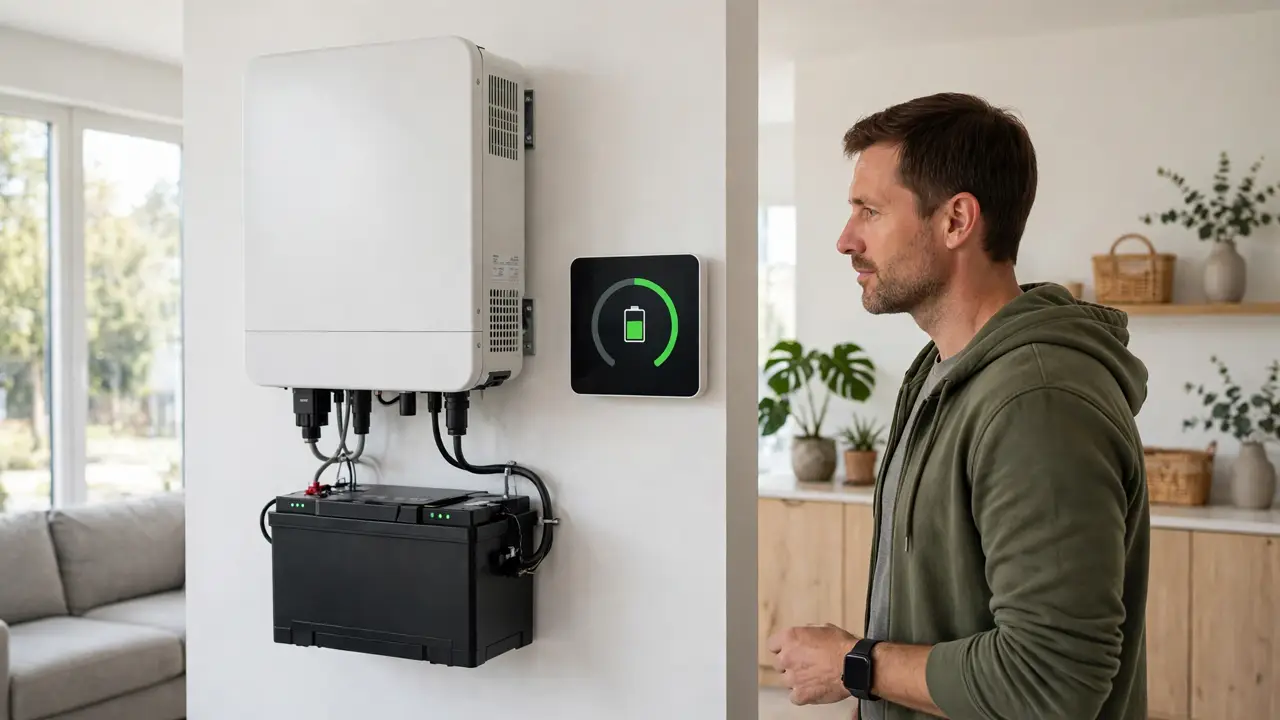
The division above gives you the capacity answer, but the bank must also match your system’s voltage. Most home hybrid systems run at 48 volts. A single 12-volt tubular battery cannot feed a 48-volt inverter on its own; four 12-volt batteries wired in series make 48 volts, so tubular banks are usually built in multiples of four for a 48-volt system. If your capacity calculation says you need 5 tubular batteries, you would normally step up to 8 (two series strings of four in parallel) to keep the voltage correct and the strings balanced.
Lithium units behave differently. Many are designed as self-contained 48-volt modules that simply stack in parallel, so adding one more unit adds capacity without changing the voltage. That is one reason lithium banks scale more neatly, and it is also why you should never mix old and new batteries, or different models, in one bank: the weakest unit limits the whole bank, and mismatched units age unevenly.
Can Your 5kW Array Recharge the Bank You Just Sized?
Sizing the bank is only half the job. The array must also be able to refill it on a normal day, or the bank will slowly fall behind and leave you short on cloudy stretches. A 5kW array in Pakistan typically generates a useful amount of energy on a clear day, but the exact figure depends on your roof angle, shading, panel orientation and season, and some of the daytime generation is used by the home itself while the sun is up.
As a planning check, compare your bank’s daily recharge need with what your array can spare after daytime loads. If your bank needs 10 kWh of recharge and your home already uses most of the daytime generation, the bank may not refill fully each day, and you should either trim the backup list or plan for a larger array.
Common Mistakes That Lead to the Wrong Battery Count
The first mistake is sizing from panel watts instead of loads, as discussed above. The second is using nameplate capacity instead of usable capacity, which quietly cuts your real backup time by a fifth for lithium and by half for tubular batteries. The third is forgetting surge loads: a bank and inverter that handle steady watts may still trip when a fridge compressor or air conditioner starts.
The fourth mistake is ignoring the recharge check, so the bank may not refill fully each day. The fifth is planning for loads you do not actually need on backup, such as a water heater or an iron, which inflates the bank for no benefit. And the sixth is mixing battery ages or types when expanding later; expansion should use the same model and follow the maker’s rules, or the new units will be dragged down by the old ones.
Quick Sizing Checklist for a 5kW System
- List backup loads only, with watts from nameplates and realistic running hours.
- Multiply watts by hours for each load and add them up to get your energy need in kWh.
- Divide by your battery’s usable share (check the datasheet for the DoD figure).
- Divide by one unit’s usable energy and round up to get the battery count.
- Adjust the count to fit your system voltage (multiples of four 12-volt units for 48-volt tubular banks).
- Confirm the inverter can handle your largest motor’s surge and that your exact battery model is on its compatibility list.
- Check that your 5kW array can refill the bank on a normal day after daytime loads.
- Leave expansion room for one more unit rather than buying a bank you cannot grow.
Check Current Prices
Battery models and system costs change regularly, so this guide deliberately avoids figures that would go out of date. For today’s solar panel and battery prices, see the daily updated tables on the Solar Panel Price in Pakistan homepage, then bring your load list to your installer so the final bank is sized to your home, not to a generic rule of thumb.
Final Word
So, how many batteries does a 5kW solar system need? For essential evening backup, most homes need a bank of roughly 5 to 10 kWh of usable storage, which works out to around 2 modular lithium units or 5 to 8 tubular batteries, depending on the unit size and system voltage. For whole-home or longer backup, the count rises with the load list, not with the array. Run the four-step calculation above with your own loads, and you will have an answer you can defend, and a bank that actually lasts through the night. For a deeper look at the sizing method itself, see this step-by-step battery bank sizing guide.
Frequently Asked Questions (FAQs)
How many batteries does a 5kW solar system need?
There is no fixed number, because the count depends on your backup loads and hours, not on the panel wattage. For essential-load backup, most homes need roughly 5 to 10 kWh of usable storage, which works out to around 2 modular lithium units or 5 to 8 tubular batteries, depending on unit size and system voltage. Work out your own load list first, then divide by one unit’s usable energy and round up.
Does a 5kW solar system need batteries at all?
No. A grid-connected solar system works without batteries, sending extra daytime generation to the grid and drawing from the grid at night. Batteries are only needed if you want backup during outages or want to store daytime generation for evening use, which requires a hybrid or off-grid inverter with a battery connection.
How many tubular batteries does a 5kW solar system need?
It depends on your loads and the battery size. As an example, a 200 Ah, 12-volt tubular battery holds 2,400 Wh of nameplate energy and offers about 1,200 Wh of usable energy at 50 percent depth of discharge. A 4.9 kWh essential-load need divided by 1,200 Wh gives about 4.1, rounded up to 5 batteries, then adjusted to a multiple of four for a 48-volt system, which means 8 in practice.
Is one lithium battery enough for a 5kW solar system?
Sometimes, for a small essential load list. One 5 kWh lithium unit offers roughly 4 to 4.5 kWh of usable energy, which may cover lights, fans, a router and a fridge for an evening. If your backup list is larger, or you need backup through the whole night, one unit will fall short, so check your total load energy against the unit’s usable capacity rather than guessing.
Can I add more batteries to my 5kW solar system later?
Usually yes, if the inverter and wiring allow expansion and the new units match the existing bank. Expansion should use the same battery model and follow the maker’s expansion rules, because mixing ages, chemistries or capacities creates imbalance and the weakest unit limits the whole bank. Leave room in the inverter and wiring for one more unit when you first install.
Will a 5kW solar system fully charge its batteries every day?
Not always. The array must refill the bank after the home’s daytime loads are served, and generation varies with roof angle, shading, panel orientation and season. If daytime use already takes most of the generation, a large bank may not refill daily. Compare the bank’s recharge need with what the array can spare on a normal day before settling the bank size.
Do batteries work with any solar inverter?
No. A standard on-grid inverter normally has no battery input and cannot charge or discharge a battery. You need a hybrid or off-grid inverter with a battery connection, and your exact battery model should appear on the inverter maker’s compatibility list, with the right voltage class, current limits and communication protocol.
