
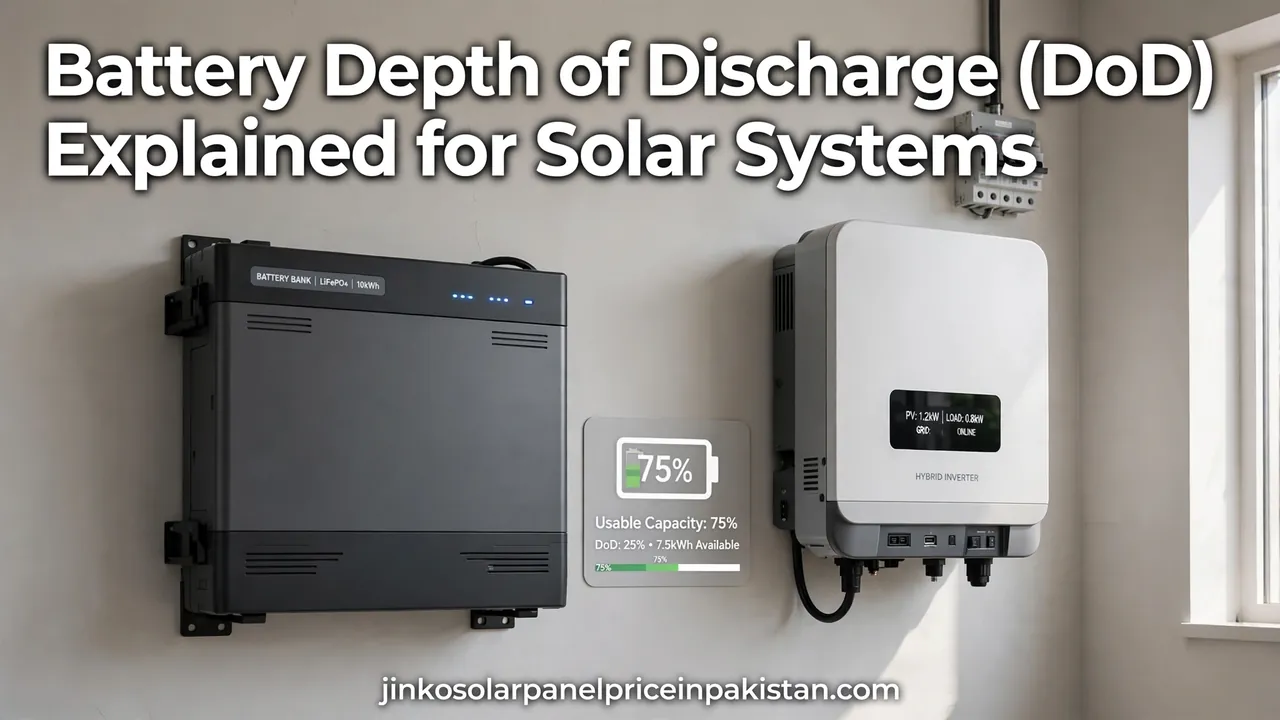
Battery Depth of Discharge (DoD) Explained for Solar Systems

Battery depth of discharge (DoD) is the percentage of a battery’s total stored energy that has been used. If a battery holds 10 kWh and you draw 5 kWh from it, its depth of discharge is 50%. Understanding DoD matters because it decides how much of your battery’s rated capacity you can actually use day after day without shortening its life — and it is one of the first numbers to check when comparing solar batteries for a home system in Pakistan.
Many buyers compare batteries by their headline capacity alone. Two batteries can both be labelled 10 kWh yet deliver very different amounts of usable energy, because each chemistry has a different recommended DoD. This guide explains what DoD means, how it relates to state of charge, how to calculate usable capacity, and how DoD affects battery lifespan and system sizing.
What Is Depth of Discharge (DoD)?
Depth of discharge measures how much of a battery’s total capacity has been consumed, expressed as a percentage. A fully charged battery sits at 0% DoD. As you use stored energy, DoD rises; when the battery is completely empty, DoD reaches 100%.
The formula is straightforward:
DoD (%) = (Energy Used ÷ Total Storage Capacity) × 100
For example, if your battery stores 10 kWh and your home uses 4 kWh from it during a load-shedding spell, the battery is at 40% DoD. The remaining 6 kWh is still in the battery, waiting to be used or kept in reserve.
Depth of Discharge vs State of Charge (SoC)
DoD and state of charge (SoC) describe the same battery from opposite directions. SoC is the percentage of capacity remaining; DoD is the percentage already used. The two always add up to 100%.
Using the example above, a battery at 40% DoD is at 60% SoC. Inverter apps and battery displays usually show SoC, because “how much charge is left” is the more intuitive reading at a glance. When a manufacturer quotes a recommended DoD, simply subtract it from 100% to find the SoC level at which the system should stop discharging — for instance, a recommended DoD of 80% corresponds to a 20% SoC cut-off.
Recommended DoD by Battery Type
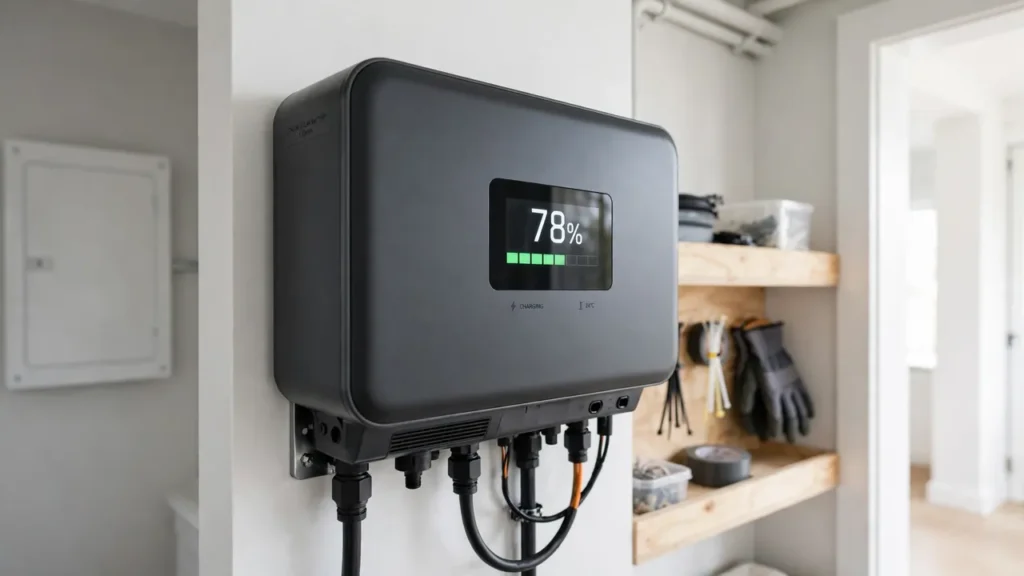
Recommended DoD depends mainly on battery chemistry. Every reputable manufacturer publishes a recommended DoD for its own models, and that figure always overrides any general rule of thumb. As a general guide, though, the commonly published recommendations are:
Lead-Acid and Tall Tubular Batteries
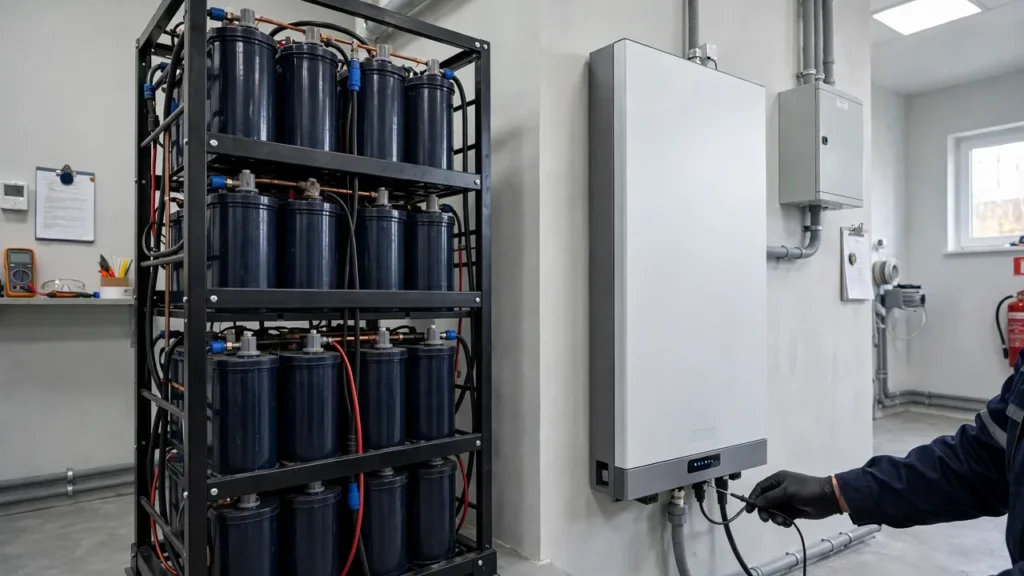
Lead-acid batteries, including the tall tubular batteries widely used in Pakistani homes, are typically recommended to discharge to around 50% DoD. Regularly going deeper causes sulfation — hard sulfate crystals build up on the plates — which permanently reduces capacity. In practice, this means roughly half of a tubular battery’s rated capacity is usable on a daily basis, with the rest held as a buffer that protects the battery.
Lithium-Ion Batteries
Lithium-ion batteries generally support a recommended DoD of around 80%. They tolerate deeper cycling far better than lead-acid, which is one reason they deliver more usable energy from the same rated capacity and typically last through many more charge cycles.
Lithium Iron Phosphate (LiFePO4) Batteries
LiFePO4, a lithium chemistry increasingly used in home solar storage, is the most forgiving of the common types, with recommended DoD figures often around 80% and some models rated higher. LiFePO4 cells also hold their voltage steadier as they discharge, so appliances keep running normally even as the battery approaches its cut-off. If you want a deeper comparison of the chemistries themselves, see our lithium battery vs dry battery comparison and our best battery buying guide for solar systems.
Usable Capacity: The Number That Actually Matters
Usable capacity is rated capacity multiplied by recommended DoD. It tells you how much energy you can realistically draw each cycle without harming the battery:
Usable Capacity = Total Capacity × Recommended DoD
Take a 10 kWh battery as an example. A tubular lead-acid battery at 50% recommended DoD gives about 5 kWh of usable energy per cycle. A lithium battery of the same 10 kWh rating at 80% recommended DoD gives about 8 kWh. Same headline number, roughly 60% more usable energy — which is exactly why comparing batteries on rated capacity alone is misleading.
This distinction matters most during load shedding. If your essential night-time load — lights, fans, Wi-Fi, a fridge — needs 6 kWh, a 10 kWh tubular bank at 50% DoD falls short, while a 10 kWh lithium bank at 80% DoD covers it. Sizing by usable capacity, not by the label, prevents the common disappointment of a battery that “runs out too early”.
How DoD Affects Battery Lifespan
DoD and cycle life are tightly linked: the deeper a battery is regularly discharged, the fewer cycles it delivers before its capacity fades. Battery cycle life is rated at a stated DoD, so a “3,000-cycle” claim only has meaning alongside the DoD it was tested at. A battery cycled gently to 30% DoD will typically outlast the same battery cycled daily to its maximum recommended DoD.
This creates a practical trade-off. Using the full recommended DoD every day gives you the most energy per cycle but wears the battery faster; keeping discharges shallower extends life but means you need a larger bank for the same nightly load. Most households land in the middle: size the bank so that a normal night takes it to roughly its recommended DoD, and treat deeper discharges as the exception — for unusually long outages — rather than the daily routine. Our solar battery lifespan guide explains the other factors, such as temperature and charging habits, that work alongside DoD to determine how long a battery lasts.
DoD Settings: Inverter Cut-Off and Battery Management
In a working solar system, you do not manage DoD by hand — the equipment does it. Hybrid and off-grid inverters let the installer set a low-voltage or low-SoC cut-off, the point at which the inverter stops drawing from the battery and either waits for solar charging or switches back to the grid. Lithium batteries add a second layer of protection: the battery management system (BMS) monitors each cell and disconnects the battery before any cell is damaged by over-discharge.
Three settings and habits are worth checking with your installer:
- Cut-off voltage or SoC: this should match your battery manufacturer’s recommended DoD, not a generic default. A cut-off set too low quietly shortens battery life; one set too high wastes usable capacity.
- Backup reserve: many hybrid inverters let you reserve a percentage of charge for emergencies. A reserve is sensible in areas with unpredictable load shedding, even though it reduces the energy available on a normal night.
- Recharge promptly: lead-acid batteries in particular should not sit for long periods in a deeply discharged state. Solar charging the next morning usually handles this, but repeated deep discharges followed by slow recharging accelerate sulfation.
Common DoD Mistakes to Avoid
- Buying on rated capacity alone. Always convert to usable capacity using the manufacturer’s recommended DoD before comparing models.
- Treating the maximum DoD as a daily target. The recommended figure is a safe limit, not an ideal. Shallower routine discharges extend battery life.
- Mixing old and new batteries. In a bank, the weakest battery sets the limit for all of them, and uneven ageing makes DoD effectively worse for the older units.
- Ignoring temperature. Batteries in hot, unventilated spaces lose capacity faster, which shrinks usable energy even when DoD settings are correct. Shade and airflow around the battery bank are cheap insurance.
- Assuming all lithium batteries are equal. Recommended DoD varies between lithium models and brands, so check the datasheet for the exact unit you are buying rather than assuming a category average.
Sizing a Battery Bank With DoD in Mind
A simple way to size a battery bank is to work backwards from your nightly load. First, estimate the energy your essential appliances use during the hours the battery must cover. Then divide that figure by the recommended DoD of the battery type you plan to buy. The result is the rated capacity you need.
For example, if your essential night-time load is 4 kWh and you choose a tubular battery with a 50% recommended DoD, you need roughly an 8 kWh bank (4 ÷ 0.50). The same load on a lithium battery at 80% recommended DoD needs roughly a 5 kWh bank (4 ÷ 0.80). This single calculation explains why lithium banks often look smaller on paper yet cover the same load — and why a tubular bank sized without DoD in mind so often disappoints. If you are still choosing between battery types, our tubular vs lithium battery comparison walks through the trade-offs in full.
Check Current Prices
Battery models, capacities and offers change regularly, so check the daily updated solar panel and battery price tables on our homepage before finalising a purchase. Pairing the DoD maths in this guide with current market figures is the surest way to buy a battery bank that covers your nightly load without paying for capacity you cannot use.
For a broader technical grounding, EcoFlow’s guide to depth of discharge for batteries explains the same concepts with worked examples across battery chemistries.
Frequently Asked Questions (FAQs)
What is battery depth of discharge (DoD)?
Depth of discharge (DoD) is the percentage of a battery’s total stored energy that has been used. A battery that has delivered 5 kWh out of a 10 kWh capacity is at 50% DoD. It tells you how much of the battery you have consumed, as opposed to state of charge (SoC), which tells you how much remains.
What is the difference between DoD and state of charge (SoC)?
DoD is the percentage of capacity already used, while SoC is the percentage remaining. The two always add up to 100%. A battery at 40% DoD is at 60% SoC. Inverter apps usually display SoC, but manufacturers state battery limits as recommended DoD.
What is a good depth of discharge for a solar battery?
It depends on chemistry, and the manufacturer’s own datasheet always takes priority. As a general guide, lead-acid and tall tubular batteries are typically recommended to around 50% DoD, lithium-ion batteries to around 80%, and LiFePO4 batteries to around 80% or higher.
How do I calculate the usable capacity of a solar battery?
Multiply the battery’s total capacity by its recommended DoD. A 10 kWh battery at 50% recommended DoD gives about 5 kWh of usable energy, while the same 10 kWh battery at 80% DoD gives about 8 kWh. Always compare batteries on usable capacity, not on the headline rating alone.
Does deeper discharge shorten battery life?
Yes. Deeper regular discharges shorten cycle life: a battery cycled daily to its maximum recommended DoD wears out faster than the same battery cycled shallowly. Size your bank so a normal night reaches roughly the recommended DoD, and treat deeper discharges as the exception for unusually long outages.
How is DoD controlled in a home solar system?
The inverter or battery management system enforces it. The installer sets a low-voltage or low-SoC cut-off that matches the manufacturer’s recommended DoD, and lithium batteries add BMS protection that disconnects before any cell is over-discharged. Never override these cut-offs without checking the battery datasheet.
How do I size a battery bank using DoD?
Divide your essential nightly energy use by the recommended DoD of the battery type you plan to buy. A 4 kWh nightly load needs roughly an 8 kWh tubular bank at 50% DoD, but only roughly a 5 kWh lithium bank at 80% DoD. This is why lithium banks can look smaller yet cover the same load.
