
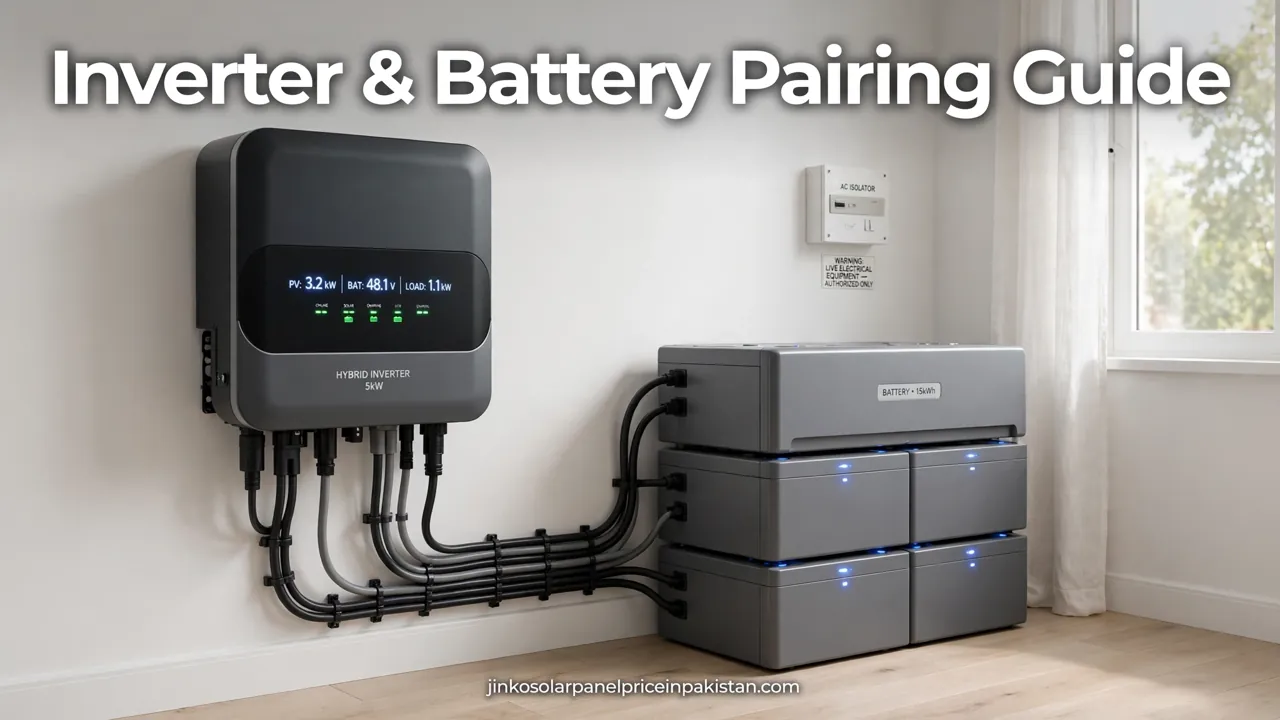
Inverter and Battery Pairing Guide: How to Match Them Correctly

An inverter and a battery are correctly paired when the inverter’s battery voltage range covers the battery’s full working voltage, the inverter’s power and current limits sit within what the battery and its BMS can safely deliver, and the two units can communicate or at least follow the same charge settings. If any one of those three checks fails, the system may refuse to start, shut down under load, charge incorrectly, or simply never use the battery properly. This inverter battery pairing guide solar buyers in Pakistan can use walks through each check in order, so you can judge a combination before you buy rather than discovering a mismatch after installation.
What Inverter and Battery Pairing Really Means
Pairing is not about buying the same brand, and it is not about matching a single number on two boxes. A hybrid inverter and a battery form one DC system: the battery stores energy as direct current, and the inverter converts that energy into the alternating current your home uses, and converts grid or solar energy back into direct current to charge the battery. For that round trip to work, the voltage, current, chemistry settings, and communication between the two units must all agree.
Think of it as a chain. The battery, its BMS (battery management system), the cables, the breaker, and the inverter’s battery port each have their own limits. The safe limit of the whole chain is the lowest limit in it. A powerful inverter cannot draw more current than the battery is willing to give, and a large battery cannot force an inverter to accept a voltage outside its range. If you are new to inverter types, our solar inverter buying guide for Pakistan explains the difference between on-grid, off-grid, and hybrid models, and why only hybrid and off-grid inverters normally work with batteries at all.
Step 1: Match the Voltage First
Voltage is the first and least flexible check. Low-voltage home systems are commonly built around 12V, 24V, or 48V nominal battery banks, while some larger lithium systems use a high-voltage battery that operates at several hundred volts. A 48V inverter cannot be paired with a 12V battery bank, and a low-voltage battery cannot be connected to a high-voltage inverter input. No setting fixes a voltage-class mismatch, so this check comes before everything else.
Do not compare nominal voltages alone. Every inverter datasheet lists a battery voltage range, and every battery has a working range from its lowest discharge cut-off to its highest full-charge voltage. The battery’s entire working range must sit inside the inverter’s permitted range. If the battery charges above the inverter’s ceiling, or discharges below its floor, the inverter will fault or shut down to protect itself.
Series and parallel wiring change the bank voltage and capacity, so the check must be done on the finished bank, not on a single battery. Connecting batteries in series adds their voltages; connecting them in parallel keeps the voltage the same and adds capacity. Our solar battery series vs parallel connection guide explains both arrangements, and why mixing old and new batteries in one bank creates imbalance even when the nominal voltage looks right.

Step 2: Match Power and Current, Not Just Capacity
The most common pairing mistake after voltage is confusing energy with power. Battery capacity, measured in kilowatt-hours (kWh), tells you how much energy the battery stores. Inverter output, measured in kilowatts (kW), tells you how much power it can deliver at one moment. A large battery paired with a small inverter will run for a long time but cannot start a heavy load; a powerful inverter paired with a small battery may demand more current than the battery can safely supply.
Work through both sides of the current check. First, list the loads you want the battery to run during an outage and add up their running watts, then check the starting (surge) demand of the largest motor-driven appliance, such as a pump or refrigerator compressor. The inverter’s continuous rating should cover the running total with headroom, and its surge rating should cover the largest start-up demand. Second, divide the power you expect to draw by the battery voltage to estimate the DC current involved, and confirm that the battery’s continuous discharge current, the BMS limit, the cable size, and the inverter’s battery port all support that current. The lowest of those figures is your real limit.
Short surge ratings deserve caution. A battery or inverter may tolerate a high current for a few seconds, but that does not make it a continuous rating. If your normal evening load sits near a surge limit, the system will trip, overheat, or shut down early. Size for the load you actually run, not the load you hope to run occasionally, and leave margin for a load you forgot to count.
Step 3: Match the Chemistry and Charge Settings
Different battery chemistries need different charging behaviour, so the inverter must offer the right charge profile for the battery you choose. Flooded and tubular lead-acid batteries, sealed AGM or gel batteries, and lithium iron phosphate (LiFePO4) batteries differ in their absorption and float voltages, their tolerance for deep discharge, and their maintenance needs. An inverter set to a lead-acid profile will not charge a lithium battery correctly, and a lithium profile applied to a lead-acid battery can overcharge it.
For lithium batteries, the BMS is part of the pairing, not an optional extra. The BMS protects the cells against over-voltage, under-voltage, over-current, and temperature extremes, and it decides how much current the battery will accept or deliver. If the inverter cannot read the BMS limits, or the installer sets charge voltages by hand without respecting them, the battery may protect itself by disconnecting at exactly the moment you need backup power. Our lithium battery guide for solar in Pakistan explains how LiFePO4 batteries differ from tubular and dry batteries, which helps you understand why their settings cannot be swapped.
Depth of discharge also belongs in this step. Usable energy is not the same as nameplate capacity: every chemistry has a recommended discharge floor, and regularly going below it shortens battery life. When you plan backup, work out usable energy from the recommended depth of discharge, not from headline capacity alone.
Step 4: Check Communication and the Compatibility List
Modern hybrid inverters and lithium batteries often talk to each other over a communication cable, using protocols such as CAN or RS-485. When communication works, the inverter follows the battery’s live state of charge, temperature, and current limits automatically, instead of guessing from voltage alone. That closed-loop operation is more accurate and safer, especially for lithium batteries, whose voltage stays fairly flat across much of their charge range and therefore reveals little about remaining energy on its own.
Before buying, ask for the inverter maker’s battery compatibility list and find your exact battery model on it, including its capacity and firmware version where the list states one. A battery that is merely the same brand, or the same chemistry, as a listed model is not the same as a listed model. If your battery is not on the list, ask the seller or installer, in writing, how the inverter will be configured: which protocol, which cable, which charge voltages, and what happens if communication drops.

Step 5: Size the Pair for Your Backup Needs
Once voltage, power, chemistry, and communication all check out, size the pair around how you will actually use it. Decide first which loads must keep running during an outage, and for how long. Essential-only backup — lights, fans, a refrigerator, a router, and phone charging — needs far less stored energy than whole-home backup, and it lets a smaller battery and inverter do the job reliably. Our best battery for solar system buying guide walks through battery types and sizing in more detail, and pairs naturally with the checks in this guide.
Then think about charging, not just discharging. A battery that is too large for the solar array or the inverter’s charger will rarely reach a full charge, especially on cloudy days, and will not deliver its rated backup when you need it. Conversely, a battery that is too small for the array will fill quickly and waste solar energy once full, unless the system can export the surplus or shift loads into the charging window. Balance the three sides — array, inverter charger, and battery — rather than maximising any one of them.
Also plan for growth. If you expect to add panels or a second battery later, check now whether the inverter and battery range allow parallel expansion. Adding a battery of a different age, chemistry, or capacity to an existing bank is one of the fastest ways to create imbalance, so expansion should use the same battery model and follow the maker’s rules.
Common Inverter and Battery Pairing Mistakes
Most pairing failures come from a small number of avoidable errors. The first is matching only the nominal voltage and ignoring the full working range. The second is sizing the inverter for the solar array while forgetting that the battery port has its own, often lower, power and current limits. The third is assuming any lithium battery works with any hybrid inverter, without checking the compatibility list or the communication protocol. The fourth is sizing the battery from its headline capacity instead of its usable energy. The fifth is mixing battery ages, types, or capacities in one bank. Each of these mistakes can leave a system that looks complete but performs poorly or shuts down under load.
A related mistake is treating the installer’s verbal assurance as the compatibility check. A reputable installer will show you the two datasheets, the compatibility list entry, and the charge settings they intend to use, and will explain which loads are on the backup output. Ask which circuits are backed up before the system is wired, not after.
Inverter and Battery Pairing Checklist
- Voltage class matches (low-voltage or high-voltage), and the battery’s full working range sits inside the inverter’s battery range.
- Continuous and surge power cover your running loads and your largest motor start-up, with headroom.
- Battery continuous discharge current, BMS limit, cables, breaker, and inverter battery port all support the current your loads will draw.
- Charge profile matches the battery chemistry, and the recommended depth of discharge has been used to work out usable energy.
- Exact battery model appears on the inverter maker’s compatibility list, with the right protocol and cable, or the fallback behaviour is documented.
- Backup circuits are agreed in advance, charging is balanced with the solar array, and any future expansion follows the maker’s rules.
- Settings are recorded after installation — battery type, charge voltages, current limits, and communication mode — so a later service visit does not have to guess.
For a broader view of the inverter side, the top 5 best hybrid inverters list shows which models are commonly discussed for home systems in Pakistan, but treat any list as a starting point only: the right pairing is decided by the datasheets and the compatibility list for your exact battery, not by a ranking.
Check Current Prices
This guide deliberately contains no prices, because inverter and battery prices change with the market and a figure in an article quickly goes out of date. For today’s updated tables, visit the homepage of jinkosolarpanelpriceinpakistan.com, where current solar panel prices are refreshed daily. Once you have a shortlist that passes the voltage, power, chemistry, and communication checks above, compare the current figures there and confirm the final combination with your installer before ordering. For background on inverter types, see the Australian Government guide: Australian Government energy guide to inverters.
Frequently Asked Questions (FAQs)
What is the first thing to check when pairing an inverter and a battery?
Check the voltage class first. The battery bank’s full working voltage range, from its lowest discharge cut-off to its highest full-charge voltage, must sit inside the inverter’s permitted battery voltage range. A voltage-class mismatch cannot be fixed with a setting.
Can any lithium battery work with any hybrid inverter?
No. The exact battery model should appear on the inverter maker’s battery compatibility list, with the right communication protocol and cable. Same brand or same chemistry alone is not proof that a particular battery and inverter are compatible.
Is battery capacity the same as backup power?
No. Capacity in kilowatt-hours tells you how much energy the battery stores, while inverter output in kilowatts tells you how much power it can deliver at one moment. Both must be checked: capacity for how long backup lasts, and power and current for which loads can run.
Why does the battery’s BMS matter for inverter pairing?
The BMS protects lithium cells against over-voltage, under-voltage, over-current, and temperature extremes, and it sets the current the battery will accept or deliver. When the inverter can read those limits through communication, charging and discharging follow the battery’s real condition instead of a voltage guess.
What happens if the inverter is larger than the battery can support?
The system is limited by the weakest part of the chain. If the inverter demands more current than the battery or its BMS can safely deliver, the battery may disconnect, the inverter may shut down under load, or the system may trip during normal use.
Should I size a battery from its headline capacity?
No, size it from its usable energy. Every chemistry has a recommended depth of discharge, so part of the headline capacity is normally kept in reserve to protect battery life. Backup planning should use the usable figure, not the nameplate figure.
Can I add a different battery to an existing battery bank later?
It is not recommended. Mixing batteries of different ages, chemistries, or capacities in one bank creates imbalance, because the weaker or different units limit the whole bank. Expansion should use the same battery model and follow the maker’s expansion rules.
Do I need a hybrid inverter to use a battery with solar panels?
In most home systems, yes. A standard on-grid inverter normally has no battery input, so it cannot charge or discharge a battery. Hybrid and off-grid inverters include a battery connection and the charging controls a battery system needs.
