
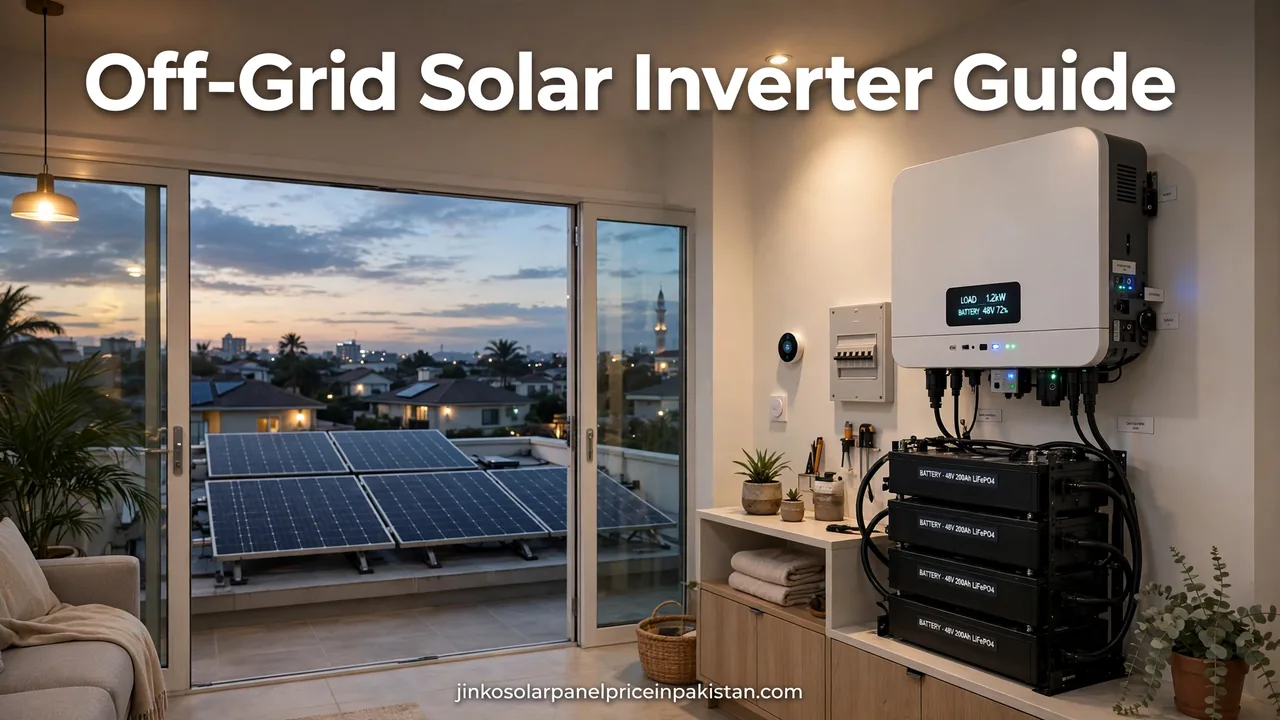
Off-Grid Solar Inverter: Complete Guide for Pakistan

An off-grid solar inverter is the heart of a solar system that works without any connection to the national grid. It takes the direct current (DC) electricity stored in your battery bank and converts it into the alternating current (AC) electricity your home appliances use, so your lights, fans, fridge and other loads keep running during load shedding, at night and in areas where the grid does not reach at all. If you are planning a fully independent solar setup in Pakistan, understanding how this inverter works — and how it differs from on-grid and hybrid inverters — is the first step to getting the system right.
What Is an Off-Grid Solar Inverter?
An off-grid solar inverter is a standalone power conversion device for systems not connected to a utility grid. Unlike a standard on-grid inverter, which must synchronise with the grid and normally shuts down during a power cut, an off-grid inverter forms its own independent supply: it draws energy from a battery bank, creates stable AC output on its own, and keeps essential loads running while the batteries have charge.
How Does an Off-Grid Solar Inverter Work?
An off-grid system works as a continuous cycle of generation, storage and conversion. Each part has a clear job, and the inverter coordinates the final step.
Step 1: Solar panels generate DC electricity
During daylight, your solar panels convert sunlight into DC electricity. On a clear day the array produces more than the home is using at that moment, and the surplus is sent toward storage instead of being wasted.
Step 2: A charge controller manages battery charging
DC electricity from the panels passes through a charge controller, which regulates voltage and current so the battery bank charges safely and is not overcharged. Many modern off-grid inverters have a built-in charge controller — often an MPPT (Maximum Power Point Tracking) controller — which also helps the panels operate at their most productive point as sunlight and temperature change through the day. You can learn more in our guide to what MPPT means in solar inverters.
Step 3: Batteries store energy for later use
The regulated DC energy is stored in the battery bank. This stored energy powers your home after sunset, on cloudy days and whenever demand exceeds panel output. Battery choice and bank size therefore decide how long your system can run without sun — see our guides to types of solar batteries and how many batteries a solar system needs before finalising your design.
Step 4: The inverter converts DC to AC
When you switch on an appliance, the inverter draws DC power from the battery bank and converts it into stable AC electricity at the voltage and frequency your home wiring expects. A good off-grid inverter holds that output steady even as loads switch on and off, which matters for sensitive electronics such as computers, routers and modern appliances with digital controls.
Step 5: Power flows to your home’s loads
The AC output feeds your home’s distribution board and your appliances. The cycle then repeats: panels recharge the batteries by day, and the inverter supplies the home from storage by night. The Australian Government’s YourHome guide describes the same arrangement — solar PV, a battery bank, conversion equipment, an inverter and often a fuel generator — and notes that off-grid systems must be designed for periods of low solar generation.
Main Components of an Off-Grid Solar System
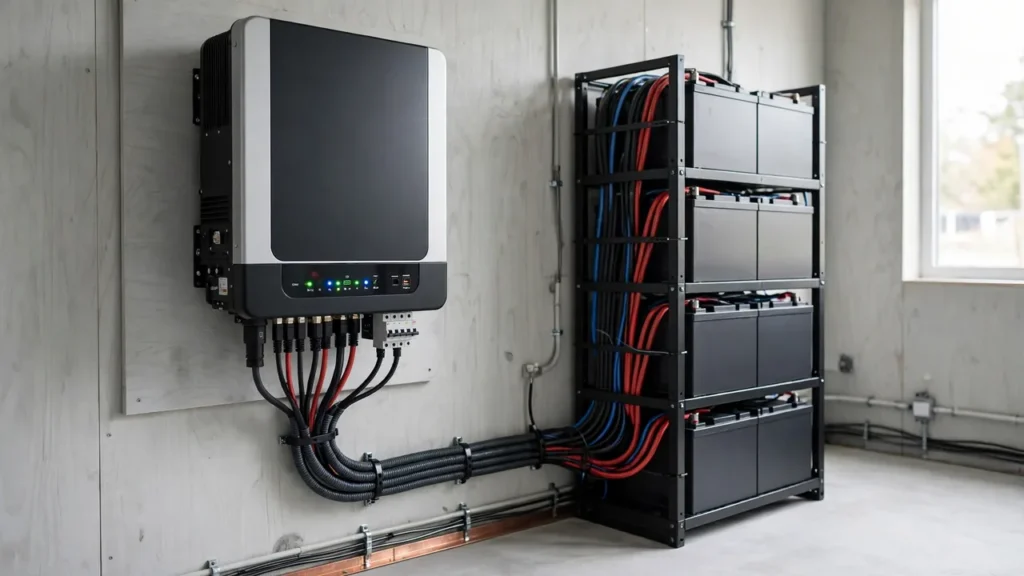
An off-grid inverter never works alone. A complete system normally includes:
- Solar panels: generate DC electricity from sunlight.
- Charge controller: regulates charging and protects the battery bank from overcharging. Often built into the inverter.
- Battery bank: stores energy for night-time and low-sun periods. Its usable capacity, chemistry and depth of discharge shape how much backup you actually get.
- Off-grid inverter: converts stored DC into AC and forms the home’s independent power supply.
- Wiring and protection: breakers, fuses, disconnects and correctly sized cables, plus earthing for safety.
- Optional generator: a fuel generator can top up batteries during long cloudy spells and is a common backup for remote sites.
Off-Grid vs On-Grid vs Hybrid Inverter
These three inverter types are often confused, and choosing the wrong one is one of the most common planning mistakes. The difference comes down to what the system is connected to and what happens during a power cut.
On-grid inverter: works with the utility grid, normally exports surplus energy where the rules allow, and — in a standard grid-tied setup — stops supplying power during a grid outage for safety. It has no battery bank of its own, so it cannot provide backup on its own.
Off-grid inverter: works entirely independently of the grid, always with a battery bank, and keeps supplying power from storage whether or not the grid exists. It cannot export to the grid because there is no grid connection to export to.
Hybrid inverter: combines both worlds — it can use solar, battery storage and the grid in one system, and can usually provide backup during outages while still interacting with the grid when it is available. For a full three-way comparison, read our on-grid vs off-grid vs hybrid inverter comparison, and for the hybrid route in detail, our hybrid solar inverter guide for Pakistan.
Short rule: with a reliable grid connection and mainly bill-cutting in mind, start with on-grid or hybrid; with no grid connection, long outages or a remote site, off-grid is the design that fits.
Who Needs an Off-Grid Solar Inverter in Pakistan?
Off-grid inverters make most sense in these situations:
- Homes beyond the grid: villages, farmhouses and remote properties where a grid connection is unavailable or unreliable.
- Load-shedding-prone areas: households that need guaranteed backup for fans, lights, a fridge and communication devices during long outages.
- Agricultural and site use: tube wells, workshops, schools, clinics and small businesses that cannot afford downtime.
- Backup for essential loads: even in grid-connected areas, some users choose an off-grid-style battery setup for a dedicated set of essential circuits.
Pure Sine Wave vs Modified Sine Wave
Most quality off-grid inverters today produce a pure sine wave output, which closely matches grid-quality AC. Sensitive electronics, motors and appliances with digital controls run more smoothly on a clean waveform, and some equipment can buzz, overheat or malfunction on a rough modified sine wave.
Check the output waveform in the datasheet rather than relying on marketing labels; pure sine wave is the safe choice for a home running a fridge, fans, a TV, a computer and a router.
How to Size an Off-Grid Inverter
Sizing an off-grid inverter is about two different numbers, and both must be right:
Continuous power rating
This is the load the inverter can supply continuously. Add up the running watts of everything you expect to run at the same time — lights, fans, fridge, TV and router — and make sure the inverter’s continuous rating comfortably covers that total, with headroom to spare.
Surge (peak) power rating
Motors in fridges, water pumps and air conditioners draw a much higher current for a few seconds when they start than they use while running. The inverter’s surge rating must handle the largest starting load in your home, otherwise the inverter may trip or shut down just as the fridge compressor kicks in. Check both ratings in the datasheet, not just the headline number on the box.
Battery bank and autonomy
The inverter is only half the system. Your battery bank decides how long you can run without sun. Plan around your daily energy use, the usable capacity of your chosen battery chemistry (lead-acid and lithium batteries differ significantly in how deeply they can be discharged), and how many cloudy days — days of autonomy — you want the system to ride through. Our guides to battery depth of discharge and how to calculate solar battery backup time walk through this math step by step.
Choosing the Right Battery for an Off-Grid System
Battery chemistry shapes cost, lifespan, usable capacity and maintenance in an off-grid system:
- Tubular lead-acid batteries: widely available in Pakistan, familiar to installers, and need regular water and terminal maintenance. See our tall tubular battery guide.
- Lithium (LiFePO4) batteries: deeper usable capacity, longer cycle life and far less routine maintenance, with a built-in battery management system (BMS) protecting each cell. See our lithium battery guide and lithium battery BMS explained.
- Dry batteries: sealed and low-maintenance, but with their own limits on depth of discharge and lifespan — compare them in our dry vs tubular battery comparison.
Whatever chemistry you choose, match the battery bank voltage to the inverter’s battery input, keep all batteries in a bank the same type, age and capacity, and never mix old and new batteries — a weak battery drags the whole bank down, as explained in our new vs used solar battery guide.
Installation and Safety Basics
- Location: install the inverter in a dry, ventilated, shaded spot, close to the battery bank to keep DC cable runs short, but with enough airflow for cooling.
- Protection: use correctly rated breakers, fuses and disconnects on both the DC and AC sides, and proper earthing for the whole system.
- Cable sizing: undersized DC cables waste energy as heat and can drop voltage enough to affect performance — size cables for the actual current and distance, not by guesswork.
- Generator input: if a generator will charge the batteries, confirm the inverter accepts generator input and set its charging limits to match the generator and battery specifications.
- Qualified installer: off-grid wiring, earthing and protection involve mains-level voltages. Use a qualified installer — see our solar inverter installation guide — and ask for the wiring diagram and manuals before handover.
Common Off-Grid Inverter Mistakes to Avoid
- Sizing by headline watts alone and ignoring surge rating — the fridge or pump starting load trips the system.
- Undersizing the battery bank and expecting a full night of backup from a bank sized only for a few hours.
- Mixing battery types or ages in one bank, which shortens the life of the whole bank.
- Skipping the charge controller’s limits — connecting more panel capacity or a higher panel voltage than the controller or inverter input allows.
- No plan for cloudy days — no autonomy target, no generator backup and no load-priority plan for when batteries run low.
- Ignoring maintenance — flooded batteries need water checks, terminals need cleaning, and vents and fans need to stay clear. Our solar battery maintenance guide covers the routine.
If something goes wrong, check battery charge, breaker positions and load size first; our error codes troubleshooting guide explains fault indications methodically.
Off-Grid Inverter or Hybrid Inverter: Which Should You Choose?
Choose an off-grid inverter if you have no grid connection, or if your priority is complete independence from the grid and you are willing to size a battery bank for that job. Choose a hybrid inverter if you have a grid connection, want backup during outages, and may want net metering or grid interaction in future — a hybrid keeps those options open. If you are still comparing models, our solar inverter buying guide for Pakistan covers types, sizing and what to check before you buy.
Check Current Prices
This guide is intentionally evergreen: it explains how off-grid inverters work and how to choose one, without listing figures that change with the market. For today’s updated solar panel prices and system tables, visit the homepage of jinkosolarpanelpriceinpakistan.com, where prices are refreshed daily.
Conclusion
An off-grid solar inverter turns stored battery energy into the AC power your home actually uses, independently of the grid. Get the fundamentals right — pure sine wave output, a continuous rating covering your simultaneous loads, a surge rating handling motor starts, and a battery bank sized for night-time use and cloudy-day autonomy — and it can deliver reliable power exactly where the grid cannot. Start with your load list, size inverter and battery together, and have the system installed by a qualified installer.
Frequently Asked Questions (FAQs)
What is an off-grid solar inverter?
An off-grid solar inverter converts the DC electricity stored in a battery bank into AC electricity for home appliances, without any connection to the utility grid. It forms its own independent power supply, so it keeps running during load shedding and in areas where the grid does not reach.
Does an off-grid inverter need batteries to work?
Yes. An off-grid inverter is designed to work with a battery bank. Solar panels charge the batteries through a charge controller, and the inverter draws on that stored energy to power your home at night, on cloudy days and whenever panel output is lower than demand.
What is the difference between an off-grid and a hybrid inverter?
An off-grid inverter works entirely independently of the grid and cannot export electricity to it. A hybrid inverter combines solar, battery storage and the grid in one system, so it can provide backup during outages while still interacting with the grid when it is available.
Can an off-grid inverter run a fridge and a water pump?
Yes, provided the inverter is sized correctly. You must check both its continuous rating, which covers everything running at once, and its surge rating, which must handle the much higher starting current of motors in fridges and pumps for a few seconds.
Should I choose a pure sine wave off-grid inverter?
Yes, for a home system. Pure sine wave output closely matches grid-quality AC, so sensitive electronics, motors and appliances with digital controls run smoothly and quietly. Some equipment can buzz, overheat or malfunction on a rough modified sine wave.
How do I size an off-grid inverter and battery bank?
Size them together, not separately. Add up the running watts of everything you expect to use at the same time for the inverter’s continuous rating, check the largest motor’s starting load against its surge rating, then size the battery bank for your daily energy use, usable depth of discharge and how many cloudy days you want it to cover.
Can a generator be used with an off-grid inverter?
Yes, many off-grid systems use a fuel generator as backup. The generator tops up the batteries during long cloudy spells. Confirm the inverter accepts generator input and set its charging limits to match both the generator and the battery specifications.
What maintenance does an off-grid inverter system need?
Keep the inverter ventilated and dust-free, check flooded battery water levels and terminals regularly, keep vents and fans clear, and check breakers and connections from time to time. A qualified installer should inspect the system if it trips repeatedly or shows a fault indication.
