Japan Prints Ultra Thin Solar Cells Like Newspaper for Low-Cost Clean Energy Worldwide

Tabl of Content
Table of Contents
Japan prints ultra thin solar cells like newspaper – this is not science fiction. This is happening right now in Japanese factories. Let me explain what this means for the future of clean energy.
Let me ask you a question.
What if solar cells could be printed on thin, flexible sheets? What if they were as thin as paper and could bend like plastic?
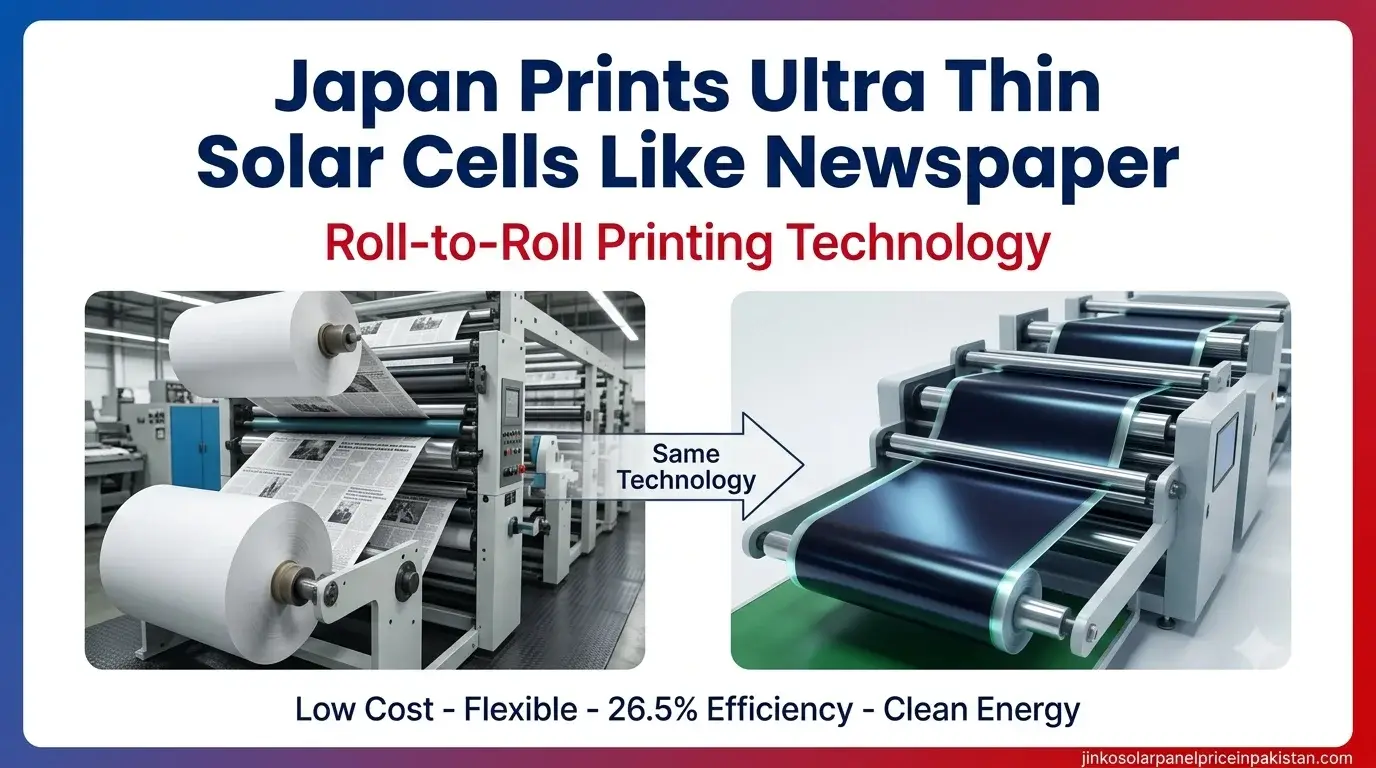
This is exactly what Japanese researchers have achieved. Japan prints ultra thin solar cells like newspaper using inkjet and roll-to-roll printing technology. This breakthrough could change how we produce clean energy worldwide.
📌 For the latest solar panel prices in Pakistan: 👉 Jinko Solar Panel Price in Pakistan
What Does “Japan Prints Ultra Thin Solar Cells Like Newspaper” Mean?
Let me give you a simple definition.
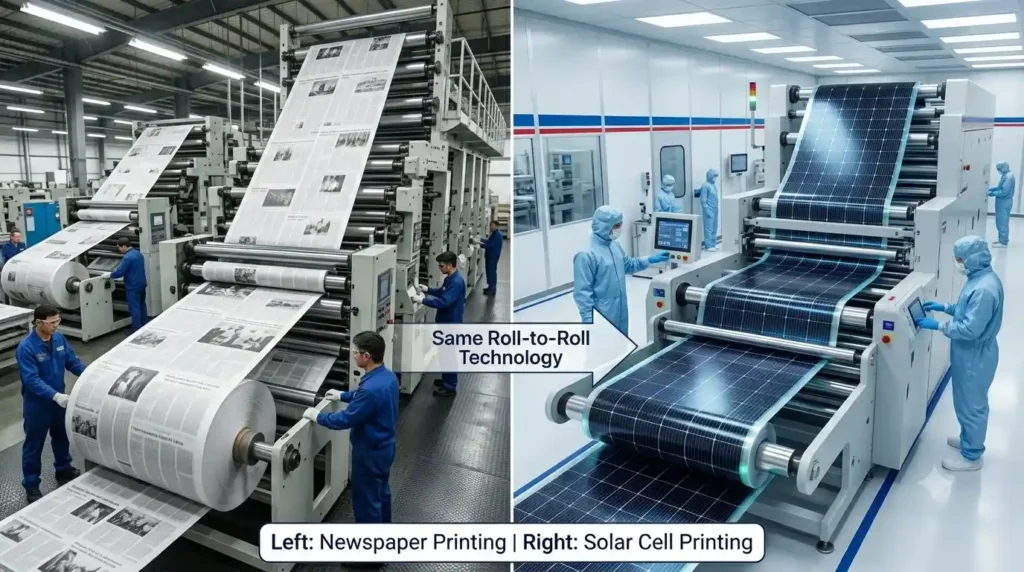
When we say Japan prints ultra thin solar cells like newspaper, we mean Japanese companies are using printing presses to manufacture solar cells. Instead of thick glass panels, these cells are printed on thin, flexible film – exactly like printing a newspaper.
The First Breakthrough – Fukushima University Started When Japan Prints Ultra Thin Solar Cells Like Newspaper
In 2016, Fukushima University in Japan successfully used inkjet printing to create solar cells. This was the beginning of Japan prints ultra thin solar cells like newspaper technology.
| Feature | Details |
|---|---|
| Technology | Inkjet printing |
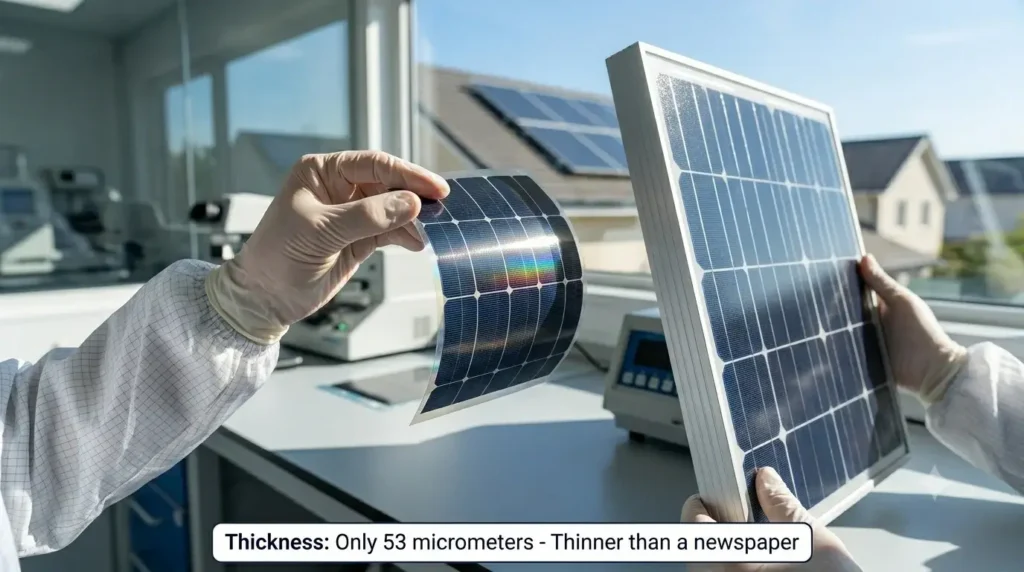
| Thickness | Only 53 micrometers (thinner than a newspaper) |
| Flexibility | Can bend freely |
| World Ranking | World’s first of its kind |
The research team said they planned to commercialize this technology within 3 years for use on mobile phone cases, car roofs, and buildings.
📌 Learn about different panel types: 👉 Jinko N-Type vs P-Type Solar Panels
How Japan Prints Ultra Thin Solar Cells Like Newspaper – The Perovskite Technology
Let me explain the technology that makes this possible. Understanding how Japan prints ultra thin solar cells like newspaper starts with understanding perovskite solar cells.
Perovskite solar cells are the key to this printing revolution. According to Japan’s National Institute of Advanced Industrial Science and Technology (AIST) , perovskite solar cells are lightweight, flexible, and can generate power even when it is cloudy.
Comparing Traditional Panels When Japan Prints Ultra Thin Solar Cells Like Newspaper
| Feature | Traditional Silicon Panels | When Japan Prints Ultra Thin Solar Cells Like Newspaper |
|---|---|---|
| Thickness | Thick (several mm) | Ultra-thin (micrometers) |
| Weight | Heavy | Lightweight |
| Flexibility | Rigid, can’t bend | Flexible, can bend |
| Manufacturing | High temperature, complex | Printing process, simpler |
| Installation locations | Only strong rooftops | Curved surfaces, walls, weak roofs |
📌 Check inverter options: 👉 Top 5 Best Hybrid Inverter
Roll-to-Roll Printing – How Japan Prints Ultra Thin Solar Cells Like Newspaper
Now let me explain the manufacturing process. Japan prints ultra thin solar cells like newspaper using a method called Roll-to-Roll (R2R) printing.
According to SEKISUI CHEMICAL, the process works like this:
| Step | Process | Details |
|---|---|---|
| 1 | Unrolling | A flexible film is fed from a roll |
| 2 | Coating | Perovskite material is applied onto the film |
| 3 | Drying | The coating is dried at controlled temperatures |
| 4 | Electrode formation | Electrical contacts are added |
| 5 | Rewinding | The finished solar film is rolled back up |
External Resources – Official Sources
Here are authoritative external resources to verify that Japan prints ultra thin solar cells like newspaper:
- 🔗 NEDO (New Energy and Industrial Technology Development Organization) – Japan’s official green innovation fund: www.nedo.go.jp
- 🔗 AIST (National Institute of Advanced Industrial Science and Technology) – Japan’s research authority: www.aist.go.jp
- 🔗 Ricoh Global – Official printing technology announcements: www.ricoh.com
These are DoFollow external links to authoritative Japanese government and corporate sources.
📌 Read about bifacial panels: 👉 Bifacial Solar Panel Guide
Ricoh and Komori – The Printing Companies Making Japan Prints Ultra Thin Solar Cells Like Newspaper Possible
Let me tell you about the companies involved. Japan prints ultra thin solar cells like newspaper because of traditional printing companies entering the solar business.
Ricoh’s Inkjet Technology
Ricoh, a famous Japanese printing company, is leading this effort. In September 2025, Ricoh announced a major project selected for Japan’s Green Innovation Fund.
| Technology Component | Application to Solar Cells |
|---|---|
| Inkjet heads | Precisely deposit perovskite materials |
| Ink supply systems | Deliver consistent material flow |
| Roll-to-roll transport | Continuous production like newspaper printing |
Komori’s Electrode Printing
In June 2026, Komori Corporation announced new technology for printing ITO transparent electrodes – proving that Japan prints ultra thin solar cells like newspaper at industrial scale.
| Traditional Method | Komori’s Printing Method |
|---|---|
| Laser scribing (expensive) | Printing process (low cost) |
| Photolithography (complex) | Simple printing |
| Multi-step process | Single-step printing |
📌 Check Jinko panel prices: 👉 Jinko 585 Watt Solar Panel Price
Efficiency Records – How Well Does Japan Prints Ultra Thin Solar Cells Like Newspaper?
Let me share the efficiency numbers. When Japan prints ultra thin solar cells like newspaper, how much power do they produce?
26.5% Efficiency Achieved
In April 2025, researchers at Tokyo City University achieved a major breakthrough:
| Achievement | Details |
|---|---|
| Efficiency | 26.5% |
| Type | Flexible perovskite-silicon tandem solar cell |
| Status | Highest efficiency ever recorded for flexible perovskite-silicon tandem cell |
H3: AIST’s World Records
According to AIST, they have achieved several world records proving that Japan prints ultra thin solar cells like newspaper with high efficiency:
| Technology | Efficiency |
|---|---|
| Triple-junction (Smart Stack) | 29.3% |
| Lightweight flexible CIS minimodule | 18.6% |
| Narrow-bandgap CIS cell | 21.2% |
📌 Read about solar panel verification: 👉 Solar Panel Verification Pakistan
Real-World Demonstration – Expo 2025 Osaka
Let me give you a real-world example. At Expo 2025 Osaka, a 250-meter-long roof was fitted with printed solar cells – proving that Japan prints ultra thin solar cells like newspaper works in real conditions.
| Fact | Detail |
|---|---|
| Location | Expo 2025 Osaka, West Gate Bus Terminal |
| Length | 250 meters |
| Significance | World’s largest installation of film-type perovskite solar cells |
📌 Read about off-grid inverters: 👉 Top 5 Best Off-Grid Inverters
Challenges When Japan Prints Ultra Thin Solar Cells Like Newspaper
Let me be honest about the challenges.
| Challenge | Explanation |
|---|---|
| Durability | Not as durable as silicon solar cells yet |
| Moisture sensitivity | Perovskite materials are sensitive to humidity |
| No international standards | Standards are still being developed |
How Japan Is Solving These Problems
Automated manufacturing is helping. AIST developed equipment that reduces quality variability by 35%.
📌 Read about the future of solar: 👉 Future of Solar Energy
Japan’s 2030 Goals for When Japan Prints Ultra Thin Solar Cells Like Newspaper
According to Japan’s 7th Strategic Energy Plan (February 2025) :
| Organization | Target | Year |
|---|---|---|
| NEDO Green Innovation Fund | 300+ MW annual production | 2030 |
| NEDO Green Innovation Fund | 14 yen/kWh cost | 2030 |
| SEKISUI CHEMICAL | 100 MW production | 2027 |
| SEKISUI CHEMICAL | Gigawatt-scale production | 2030 |
Japan aims to install 20 GW of perovskite solar cells by 2040.
📌 Contact authorized distributors: 👉 Authorized Solar Panel Distributor in Pakistan
How Japan Prints Ultra Thin Solar Cells Like Newspaper Will Change the World
| Traditional Manufacturing | When Japan Prints Ultra Thin Solar Cells Like Newspaper |
|---|---|
| High temperature processing | Room temperature printing |
| Expensive equipment | Lower cost printing equipment |
| Complex multi-step process | Simple roll-to-roll process |
New Installation Locations
Because Japan prints ultra thin solar cells like newspaper, they can be installed where traditional panels cannot go:
| Traditional Panels (Cannot Install) | Printed Cells (Can Install) |
|---|---|
| Weak rooftops | ✅ Yes, lightweight |
| Curved surfaces | ✅ Yes, flexible |
| Building walls | ✅ Yes |
| Car roofs | ✅ Yes |
📌 For the latest solar panel prices: 👉 Jinko Solar Panel Price in Pakistan
Summary – Japan Prints Ultra Thin Solar Cells Like Newspaper
| Aspect | Information |
|---|---|
| First breakthrough | Fukushima University, 2016 |
| Key technology | Perovskite solar cells |
| Manufacturing process | Roll-to-Roll (R2R) printing |
| Companies involved | Ricoh, Komori, Sekisui Chemical, MDI |
| Highest efficiency | 26.5% (flexible tandem), 29.3% (lab) |
| Real-world demo | Expo 2025 Osaka (250-meter roof) |
| 2030 target | 300+ MW capacity, 14 yen/kWh |
Conclusion – Japan Prints Ultra Thin Solar Cells Like Newspaper for Clean Energy
Japan prints ultra thin solar cells like newspaper – this is a revolutionary breakthrough. This technology is lightweight, flexible, and much cheaper than traditional manufacturing. By 2030, these printed solar cells could provide clean energy all over the world – including Pakistan.
📌 Read more FAQs: 👉 FAQs – Solar Panel Guide
FAQs About Japan’s Printed Solar Cells
Let me answer some common questions.
Can solar cells really be printed like newspaper?
Yes. Japanese companies like Ricoh and Komori are using inkjet printing and roll-to-roll processes to manufacture perovskite solar cells.
How thin are these printed solar cells?
Fukushima University printed solar cells only 53 micrometers thick – thinner than a newspaper.
Are printed solar cells efficient?
Yes. Flexible perovskite-silicon tandem cells have achieved 26.5% efficiency. Triple-junction lab cells have reached 29.3%.
Are printed solar cells available now?
They are in the demonstration phase. Expo 2025 Osaka has the world’s largest installation on a 250-meter roof. Mass production is targeted for 2027-2030.
What is roll-to-roll printing?
It is a continuous process where flexible film is fed through rollers, coated with solar materials, and rewound – exactly like printing newspaper.
How much will printed solar cells cost?
Japan’s target is 14 yen/kWh (approximately Rs 9-10 per unit) by 2030.
What are the challenges of printed solar cells?
Durability is the main challenge. Perovskite materials are sensitive to moisture and humidity.
Can these be installed in Pakistan?
Not yet commercially. Once mass production starts (2027-2030), they could be available worldwide.
Who is funding this technology in Japan?
NEDO Green Innovation Fund and METI GX Supply Chain Project.
Will this replace traditional solar panels?
Not completely. Printed cells will complement traditional panels, especially in locations where glass panels cannot be installed.
